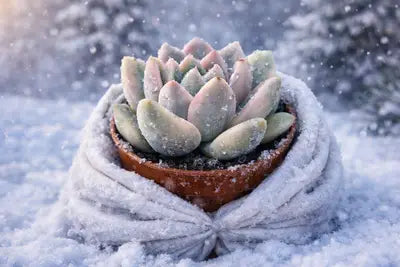
<tc>Variegated succulents</tc>: cultivation guide and essential care
Variegated succulents : guide to cultivation and essential care
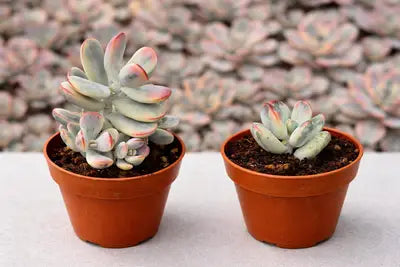
When we incorporate variegated succulents into our collection, whether from a physical nursery or an online purchase, the first step should not be watering or repotting, but observation.
Even when acquiring them from specialized establishments, it is advisable to check the general condition of the plant before integrating it with the rest. The initial acclimatization directly influences its adaptation and subsequent development.
In in-person purchases, it is common for them to come planted in very organic substrates, designed for rapid production. In these cases, replacing the substrate with a more mineral one is advisable.
After acquisition, it is advisable to keep them in partial shade for a few days, plant them in slightly moist substrate, and postpone the first watering until they show signs of adaptation.
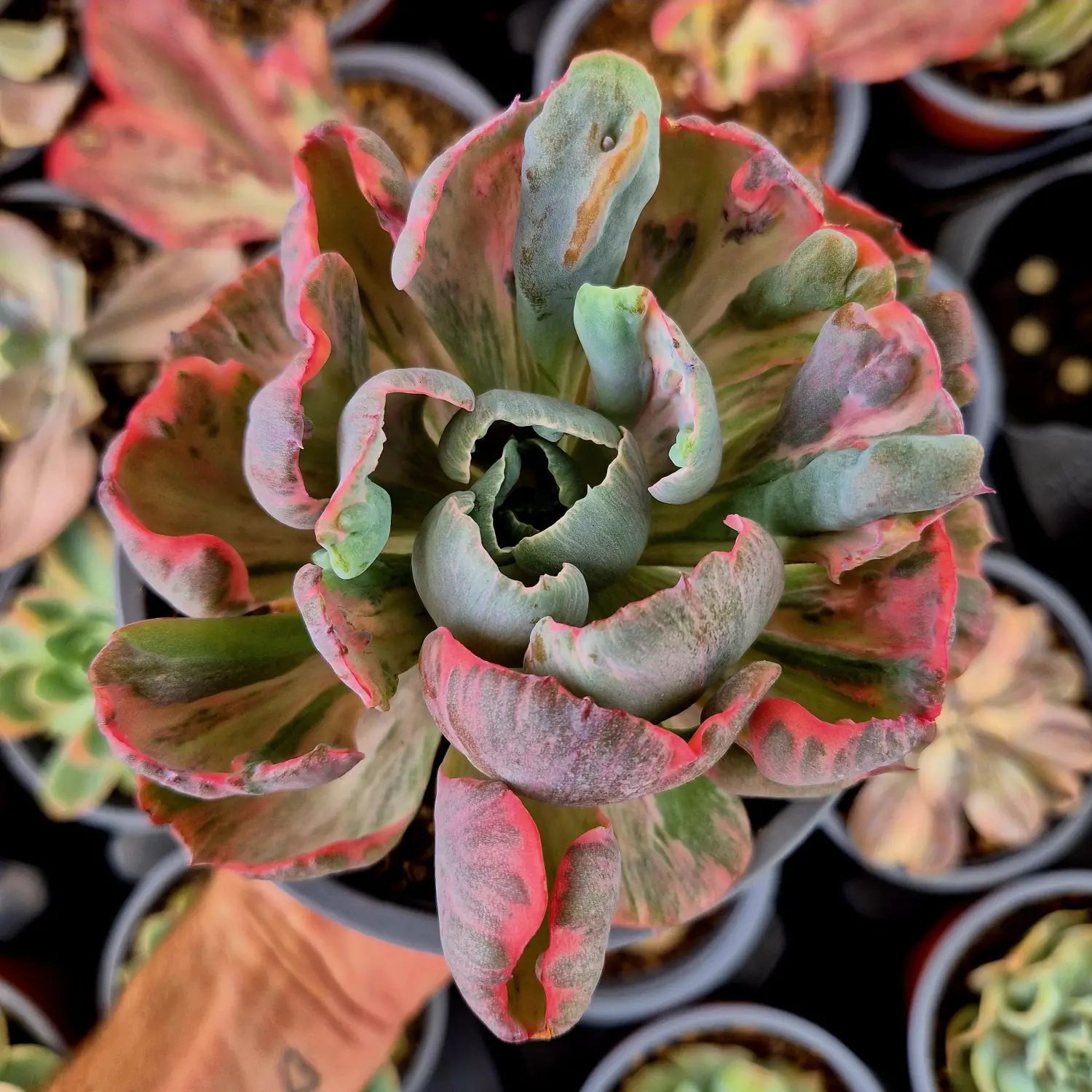
Differences compared to non-variegated succulents
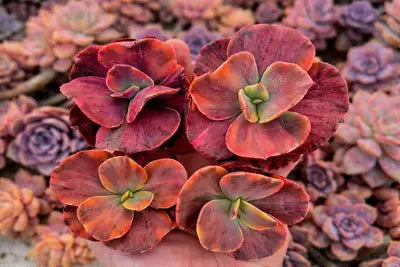
This type of succulent exhibits areas with partial absence of chlorophyll, which reduces their photosynthetic capacity.
This particularity affects their cultivation:
- Greater sensitivity to intense radiation.
- Slower growth rate.
- Lower tolerance to excess water.
Therefore, its handling requires greater precision than that of completely green specimens.
Understanding this physiological basis is essential for correctly applying any subsequent care.
Annual growth cycle
Although we usually apply general guidelines, the cycle of these succulents largely depends on the genus.
As a guideline, in temperate climates we find:
Summer → phase of slowing down or partial rest
Autumn → progressive reactivation
Winter → moderate activity depending on temperatures
Spring → main growth stage
These phases determine watering, transplanting, and propagation.
Difference of cycles by genus
Within the group of variegated succulents, we find very different development rhythms.
Echeveria
They concentrate their greatest activity in spring.The increase in brightness and mild temperatures favors the formation of new leaves and the compaction of rosettes.
During this period, it is appropriate:
- Adjust watering upwards.
- Perform transplants.
- Apply gentle fertilization.
- Propagate by leaf or apical cutting.
In summer, they may partially stop their growth due to extreme heat.
Graptopetalum and Pachyphytum
They activate their development mainly in autumn. After summer stress, they restart growth and leaf production.
It is an optimal phase for:
- Resuming gradual watering.
- Carrying out propagations.
- Avoiding interventions during the summer.
Knowing these rhythms prevents crop imbalances.
Light and exposure
Lighting is one of the most determining factors.
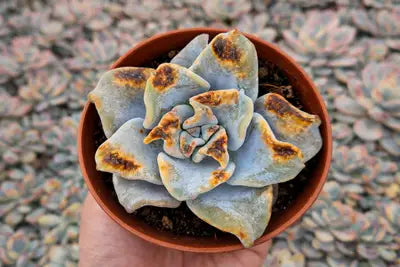
During the summer, variegated succulents should be protected from direct sunlight during peak hours. Bright areas lack protection against radiation and may suffer irreversible necrosis.
In milder seasons, they tolerate more intense exposures, which improves coloration and structural compactness.
Location stability
Constant changes in location can generate stress.
Plants adapt their physiology and orientation to the light environment. Repeatedly altering that stability weakens their development and affects their aesthetics.
Maintaining a fixed location favors their vegetative balance.
Recommended substrate
Drainage is a priority in the cultivation of variegated succulents.
A balanced mix would be:
50% universal substrate
25% pumice
25% volcanic gravel
This composition ensures root aeration and reduces the risk of rot.
Pot size
The volume of the pot directly influences water management.
Variegated plants, growing more slowly, do not require large substrate reserves. Oversized pots prolong internal moisture and increase the risk of root pathologies.
Using fitted containers allows:
- Faster drying.
- Better oxygenation.
- Greater control of watering.
- More compact growth.
Watering variegated succulents
Watering should always be adapted to the environment, season, and type of pot.
Immersion irrigation technique
Immersion irrigation is especially recommended for variegated succulents.
It consists of hydrating the substrate from the base by placing the pot in water for a few minutes.
This method allows:
- To moisten the root ball evenly.
- To improve water absorption.
- To avoid salt accumulation.
- Not to wet leaves or growth centers.
Keeping the aerial part dry significantly reduces the occurrence of foliar fungi and apical rot.
After each watering, the substrate must be allowed to dry completely.
Fertilization
Its nutritional needs are moderate.
Fertilization is only recommended when the substrate is depleted or the root volume is limited.
A low nitrogen NPK (4-1-5) fertilization prevents weak growth and loss of variegation.
Propagation
Propagation should be carried out during active growth phases.
The cuts close to the rosette usually generate more vigorous rooting and higher quality shoots.
Reversion
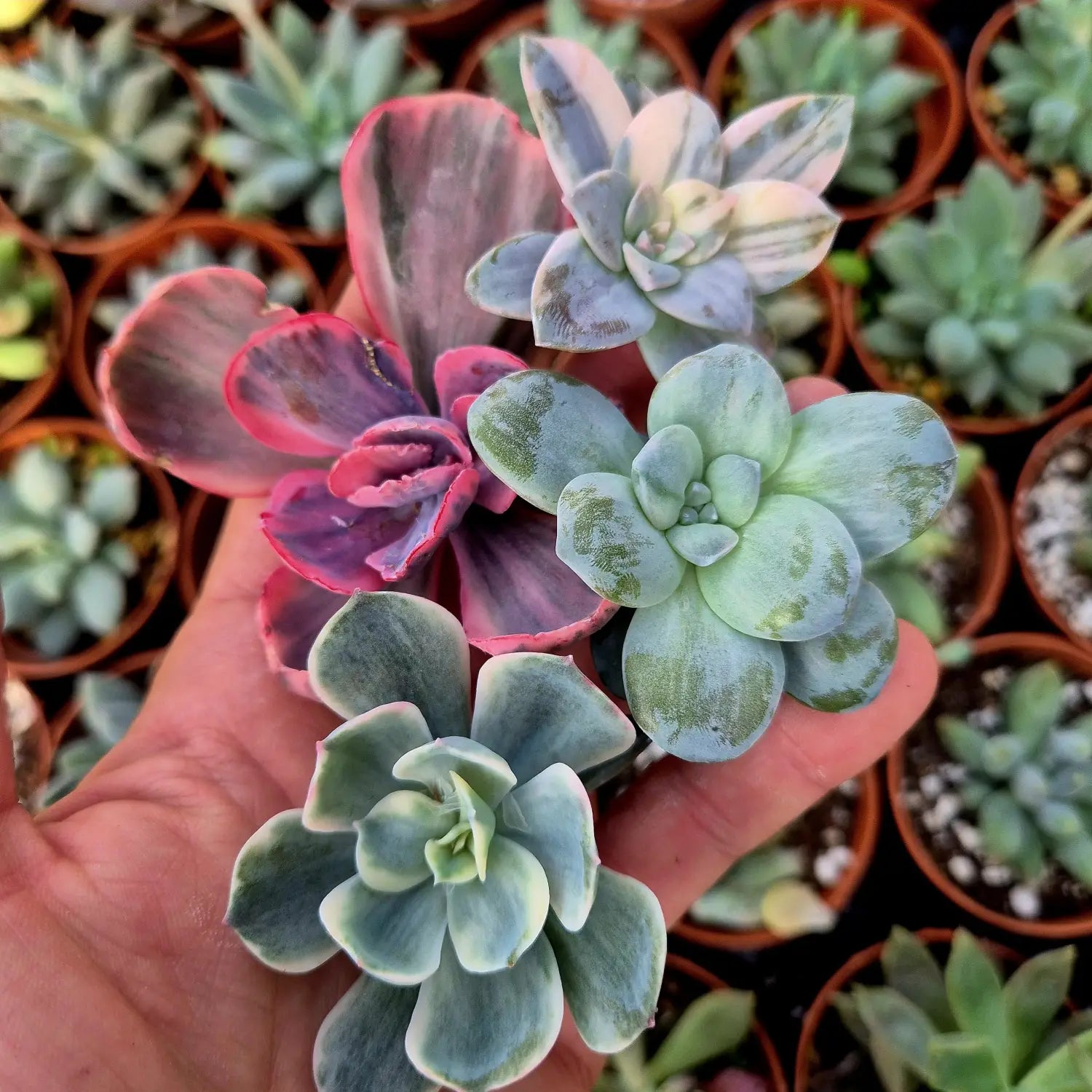
As they are genetic mutations, these plants can generate unstable tissues. This manifests mainly in two forms: completely green shoots (reversion) or albino tissues without chlorophyll.
When reversion or albinism appears in the main rosette, the situation requires intervention. If the dominant head loses its variegation or becomes albino, the plant compromises its ornamental value and even its viability.
In these cases, it is advisable to cut the rosette in an area where there is still a balanced variegation, aiming to encourage new shoots that recover the original pattern. This type of corrective pruning allows, in many cases, to reestablish the genetic stability of the plant.
If the eliminated rosette is completely reverted, it can be planted independently. It will grow as a normal green succulent, without variegation. On the contrary, an albino rosette lacks photosynthetic capacity, making it unviable in the long term and it ends up dehydrating; in these cases, it is appropriate to discard it.
When reversion or albinism appears only in lateral shoots, the management depends on the grower's discretion.Albino shoots consume resources without providing energy, weakening the overall plant, so their removal is often recommended. Reverted shoots, on the other hand, do perform photosynthesis: they provide vigor, although they can detract from the prominence of the variegation if allowed to develop unchecked. In ornamental collections, the removal of both is prioritized to maintain aesthetics. In weakened plants, retaining green shoots can be used as a temporary recovery strategy. Stability of the variegation The intensity and definition of the variegation depend on several cultivation factors: Level of light exposure. Nutritional balance.
Proper lighting and contained fertilization promote more stable contrasts.
Climate adaptation
Each environment requires specific adjustments.
Factors such as temperature, ambient humidity, ventilation, or frost risk condition the management of the crop.
Continuous observation allows for precise care adjustments.
Conclusion
The cultivation of variegated succulents requires attention to details that, although simple, are decisive.
Understanding their lower photosynthetic capacity, respecting their cycles, adjusting watering, and optimizing the substrate are fundamental pillars for their proper development.
Specific guides on the cultivation of variegated succulents
If you want to delve into specific aspects of cultivation, you can find more information in our specialized guides:
- Care and propagation of variegated succulents
- How to propagate variegated succulents and maintain their variegation
- Techniques to achieve more colorful succulents
- Lunar guide for variegated succulents
- Care for variegated succulents in winter
- Mealybug on variegated succulents: how to identify and control it
- Fungi on variegated succulents: how to identify and treat them
- 10 tips for preparing your variegated succulents in spring
- Reversion and albinism in variegated succulents: causes and how to control them
- How to identify a stable variegated succulent: types of variegation and stability
-
Rare succulents : mutations, crests, and unique forms
If you want to expand your collection, you can explore our variegated succulents, as well as variegated aeoniums, rare succulents and classic variegated selected for collectors.
Follow us on Instagram to stay updated on our latest news: