How to propagate variegated succulents and maintain their variegation
Reproducing variegated succulents requires first understanding how their variegation works.
Reproducing variegated succulents is not always straightforward, as many variations exhibit some genetic instability.
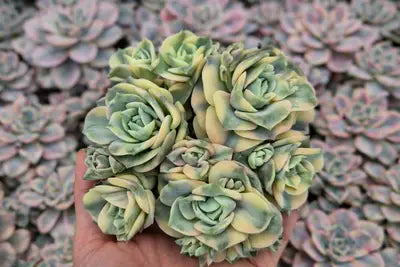
These plants exhibit a genetic alteration that affects chlorophyll production. The lighter areas contain less chlorophyll or are completely devoid of it. For this reason, their photosynthetic capacity is lower than in other specimens.
This characteristic conditions several aspects of their cultivation:
- slower growth
- greater sensitivity to environmental stress
- greater genetic instability
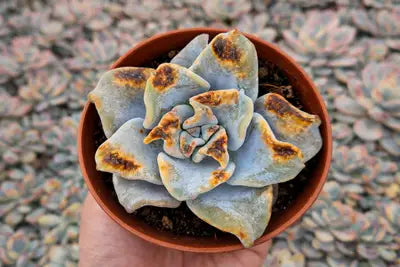
Additionally, many variegations are not completely stable.During growth or reproduction, completely green tissues (reversion) or albino tissues without photosynthetic capacity may appear.
For this reason, reproducing variegated succulents does not always guarantee obtaining new plants with the same ornamental pattern. Understanding how these mutations behave is essential to increase the chances of success.
In cultivation, there are two main methods accessible to any enthusiast: leaf propagation and cutting propagation. Additionally, in professional environments, more advanced techniques such as in vitro propagation or grafting are used.
Methods for reproducing variegated succulents
There are different ways to reproduce variegated succulents, although not all offer the same level of reliability.
The most common methods are:
- leaf propagation
- cutting or slip propagation
- in vitro propagation
- grafting
The first two are accessible to any grower. The others are mainly used in specialized production.
Reproducing variegated succulents by leaf
Leaf propagation is one of the most commonly used methods in genera such as Echeveria, Graptopetalum, or Pachyphytum.
However, when it comes to variegated succulents, the success rate tends to be quite low.
The process begins by selecting a healthy leaf with interesting variegation.This is important because the new cell growth originates from the tissues present in the leaf. If those tissues contain a balanced mix of cells with and without chlorophyll, there is a greater likelihood that the new plant will maintain that pattern.
Even so, it is common for many leaf reproductions to generate completely green plants, with very weak variegation or even albino tissues.
Our method consists of leaving the leaves in a container without substrate for the first few weeks.In this phase, the leaf enters a survival process that can lead to different responses:
- emission of new rosettes
- appearance of roots
- or both at the same time
During this period, it is important not to water the leaves, as direct moisture tends to cause rot.
Between 4 and 8 weeks , the first rosettes usually appear. At that moment, they can be transferred to a slightly moistened substrate.
It is not essential for them to have developed roots. Once in contact with the substrate, the new plant will begin to generate them progressively.
As long as the original leaf remains attached to the new rosette, it will continue to provide energy and nutrients.For this reason, it is advisable not to remove it until the new plant shows clear signs of growth and rooting.
Once developed, it remains to observe if any of the new plants maintains an interesting variegation pattern and transplant it to its final pot.
Propagation of variegated succulents by cutting
Propagation by cutting or cutting is the most reliable method when the goal is to maintain the variegation of a specific plant.
The first step is to select a mother plant with homogeneous and stable variegation.
Next, the cut is made in an area close to the rosette, preferably in relatively recent tissue.Young cells have a greater capacity for regeneration, which favors both the rooting of the cut rosette and the emergence of new shoots in the base plant.
After making the cut, it is advisable to sprinkle sulfur on the wounds to prevent the entry of pathogens.
The separated rosette should be allowed to heal for approximately between 7 and 10 days before planting it. This period allows the cut tissue to seal properly.
Once planted in slightly moist substrate, it is advisable to wait for the first roots to appear before starting normal watering.
Meanwhile, the remaining base in the pot usually reacts by activating new growth points.
In most cases, new rosettes begin to appear around the cut area between 2 and 4 weeks after the cut. These new rosettes usually retain the variegation pattern of the original plant.
For this reason, propagation by cuttings is the system that offers the highest success rate for maintaining variegation and reproducing variegated succulents.
In vitro propagation in variegated succulents
In specialized nurseries, especially in Indonesia and Thailand, in vitro propagation is used to produce large quantities of variegated succulents.
This method typically starts from meristematic tissue that is cultured under completely sterile conditions within controlled nutrient media.
From a small tissue sample, it is possible to generate hundreds of new plants.
Subsequently, producers select specimens with the most attractive variegation patterns.
The main difficulty arises in the acclimatization phase, as the plants produced in vitro must gradually adapt to cultivation under normal conditions and tend to be weaker and more prone to all kinds of problems.
Grafts on variegated succulents
Grafting has become an increasingly used technique to produce variegated succulents on a large scale.
The procedure consists of joining a variegated rosette to a vigorous rootstock that provides a powerful root system and greater photosynthetic capacity.
One of the most commonly used rootstocks is Aeonium arboreum or Kalanchoe beharensis, due to its rapid growth and the large amount of energy it can transfer to the grafted plant.
Thanks to this vigorous base, the variegated rosette receives a constant supply of resources, which translates into:
- faster growth
- stronger plants
- less tendency to reversion or weakening
This system is primarily used by Asian producers, especially in China, to rapidly multiply variegated plants and maintain a homogeneous commercial quality.
Spontaneous variegation in succulents
Occasionally, a succulent may spontaneously develop a variegated leaf. When this occurs, many growers attempt to stabilize that mutation.
The causes can be diverse:
- spontaneous cellular mutations
- late expression of a variegated pattern present in previous generations
- alterations induced by stress or chemical treatments
If the variegation appears only on one leaf or in a small area of the plant, it may be possible to reproduce that part through cutting or propagation of variegated leaves.
If the mutation proves stable, there is a possibility that the new plants will maintain that pattern.
Conclusion
Reproducing variegated succulents requires a bit more patience than reproducing non-variegated succulents, as many of these mutations exhibit a certain degree of genetic instability.
Leaf propagation allows for the experience and acquisition of new plants, although the success rate is usually low.
In contrast, propagation by cuttings offers a much higher success rate when trying to maintain the variegation of a specific plant, as the new rosettes that appear at the base usually retain the same pattern as the original rosette.
In professional production, techniques such as tissue culture or grafting allow for the multiplication of large quantities of plants while maintaining uniform quality.
Learn how to cultivate variegated succulents step by step
If you want to delve into all the essential care —substrate, watering, light, pot, or stability of the variegation— we recommend our complete cultivation guide:
If you want to expand your collection and propagate variegated succulents, you can explore our variegated succulents, as well as variegated aeoniums, rare succulents, and classic variegated selections curated for collectors.
Follow us on Instagram to see new additions and restocks: