10 Common Mistakes in Caring for Variegated Succulents | Practical Guide
Errors in variegated succulents (and how to avoid them)
Variegated succulents are particularly attractive plants, but they are also more delicate than regular succulents. Many of the errors in variegated succulents are not due to diseases, but to inadequate cultivation practices, often well-intentioned.
Identifying these faults in time allows for the prevention of problems and the maintenance of healthy and stable plants in the long term.
1. Exposing them to too much direct sunlight
One of the most common mistakes is thinking that, because they have light colors, they need more sun.
In fact:
- The non-chlorophyll tissue burns easily
- Intense sun causes irreversible spots
- Light-colored leaves are more sensitive
Solution:
Intense but filtered light, gentle morning sun or late afternoon sun, and gradual acclimatization.
2. Over-fertilizing to "speed up" growth
Variegated succulents grow more slowly naturally. Over-fertilizing does not speed up this process; it worsens it.
Common problems:
- Soft growth
- Loss of compactness
- Less defined colors
Solution:
Soft fertilizers, only during the active growth phase and always in moderation.
3. Overwatering (especially outside of growth)
Excessive watering is one of the main problems in variegated succulents, but not only in terms of quantity, but also in terms of timing.
Typical errors:
- Watering with cold
- Watering without active growth
- Using poorly draining substrates
Solution:
Water only with appropriate temperatures and completely dry substrate.
4. Watering to “reactivate” a dormant plant
Dormancy is not a problem, it is part of the plant's natural cycle.
Normal indicators:
- Closed rosettes
- Stopped growth
- Lower water consumption
Solution:
Respect dormancy. Watering does not activate growth and can cause rot.
5. Not understanding the reversion to green
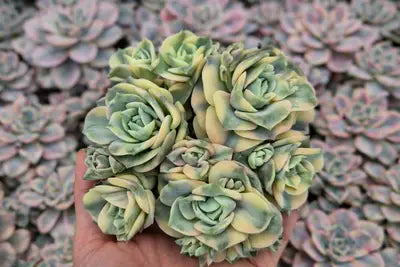
The reversion occurs when the plant produces completely green shoots to increase its photosynthetic capacity.
Key points:
- It is not a disease
- It is a survival mechanism
- It can repeat
What to do:
Remove the green shoots as soon as possible to preserve the variegation.
6.Let completely green shoots grow
If not removed, green shoots:
- Grow faster
- Consume more energy
- End up dominating the plant
Solution:
Cut them early and cleanly.
7. Try to save completely albino parts
When a variegated succulent turns completely yellow or white, it lacks chlorophyll.
Important to know:
- Cannot photosynthesize
- Lives at the expense of green tissue
- Not viable on its own
Solution:
Do not separate albino parts and accept that some cannot be maintained long-term.
8. Transplanting or pruning at the wrong time
Transplanting or pruning during dormancy:
- Delays recovery
- Increases the risk of fungi
- Generates unnecessary stress
Solution:
Always wait for active growth phases.
9.Constantly changing the location
Moving the indoor plant outside (or vice versa) generates thermal and light stress.
Solution:
Choose an appropriate location and keep it stable.
10. Treat variegated succulents like normal plants
The most common mistake of all and the source of many variegated succulents.
Variegated succulents:
- They have less margin for error
- They react sooner to excesses
- They require more observation and less intervention
Solution:
Understand that they are not “normal succulents,” but plants with specific needs.
Conclusion
Most of the errors in variegated succulents are not due to lack of interest, but to excessive intervention. Observing, respecting natural cycles, and acting only when necessary is the best way to keep these plants healthy and stable in the long term.
In our selection you will find:
Follow us on Instagram to stay updated on our latest news: