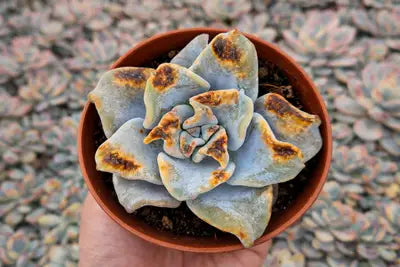
Fungi in variegated succulents: how to identify and treat them
Share
Introduction
Fungi on variegated succulents are one of the most common problems in cultivation.
The light areas of these plants contain less chlorophyll. This reduces their photosynthetic capacity and weakens some tissues.
When high humidity, poor ventilation, or compact substrates coincide, various pathogens can develop rapidly.
Detecting symptoms in time allows for action before the infection spreads.
An important warning before treating fungi
Fungal diseases spread through microscopic spores.
These spores can travel through the air, water, or contact between plants.
For this reason, the first step should always be to isolate the affected plant.
Separating the sick specimen prevents the pathogen from spreading to the rest of the collection.
Once the plant is isolated, the problem can be assessed and the appropriate treatment can be applied.
Main fungi in variegated succulents
There are many pathogens capable of infecting succulents. However, some appear more frequently in cultivation.
Knowing their symptoms facilitates a quick response.
Phytophthora and Fusarium: rot and sudden death
Two common pathogens in succulents are Phytophthora and Fusarium oxysporum.
Both usually attack plants weakened by excess moisture or compact substrates.
Phytophthora
This pathogen causes the well-known crown rot. The infection usually starts at the base of the stem.
The affected area acquires a dark brown or blackish color. The deterioration can progress rapidly.
Fusarium oxysporum
Fusarium is a soil fungus that primarily infects the roots.
It often appears when the substrate retains too much moisture. The most common symptom is rapid wilting.
How to act
It is essential to intervene quickly.
The affected part must be removed until completely healthy tissue is found.
Afterwards, it is advisable to sprinkle sulfur on the cut area to prevent new infections.
The plant must dry before being replanted in clean substrate.
Anthracnose in succulents
Anthracnose is mainly caused by fungi of the genus Colletotrichum and Glomerella.
It manifests as dark, necrotic, and slightly sunken spots on leaves or stems.
These lesions can be confused with sunburns.
The disease thrives in warm and humid environments. If it progresses, it can cause rotting.
Treatment
It is necessary to remove the affected areas.
Afterwards, it is advisable to apply copper-based fungicides, that are usually effective against these pathogens.
Powdery mildew and downy mildew in succulents
Powdery mildew and downy mildew group different fungi that affect many ornamental plants.
Both appear more frequently when there is high environmental humidity and little ventilation.
Powdery mildew
Powdery mildew is easily recognized by a whitish powder on the surface of the leaves.
It is common in temperate or warm climates with high humidity.
Downy mildew
Downy mildew usually starts with gray or brown spots.
In advanced stages, the spots can take on a dark or greasy appearance.
Treatment
First, the damaged leaves should be removed.
Then, it is advisable to apply sulfur powder over the entire plant.
The treatment is usually repeated every two weeks.
During this process, it is advisable to keep the plant in light shade.
How to know if my succulent has fungi
Symptoms that quickly suggest if we have fungi in our succulents.
The most common are:
dark spots on leaves
soft or watery areas
circular spots that expand
white powder on the leaves
tissues that turn black or brown
Variegated areas tend to show symptoms before the rest of the plant.
What to do if fungi appear on a succulent
When an infection appears, it is important to act quickly.
The basic steps are usually:
Immediately isolate the affected plant.
Remove damaged leaves or tissues.
Check the watering and ventilation conditions.
Apply fungicide if necessary.
In many cases, correcting the growing conditions stops the progression of the problem.
How to prevent fungi in variegated succulents
Prevention is the best strategy against fungi in variegated succulents.
A balanced cultivation greatly reduces the appearance of pathogens.
Well-draining substrates
Succulents need mixes with good aeration.
Substrates that are too organic promote the appearance of rot.
Proper ventilation
Moving air helps to dry the surface of the plant.
This hinders the development of many fungi.
Avoid wetting the aerial part
Watering directly on the leaves promotes the germination of spores.
Whenever possible, it is advisable to water only the substrate.
Mycorrhizae in succulents: improving roots and resistance
The incorporation of mycorrhizae in the substrate can improve the overall health of the plant.
Mycorrhizae are beneficial fungi that establish a symbiosis with the roots.
This association expands the root absorption surface.
As a result, the plant can absorb water and nutrients more efficiently.
Among its benefits are:
better rooting
greater nutrient absorption
greater resistance to water stress
greater tolerance to soil pathogens
A strong root system allows the plant to respond better to stress.
Trichoderma: biocontrol against soil fungi
The use of Trichoderma is a very effective strategy to prevent rot in succulents and cacti.
Trichoderma is a beneficial fungus that colonizes roots and substrate.
Once established, it competes directly with soil pathogens.
This reduces the space and resources available for harmful fungi.
It also produces compounds that inhibit the growth of certain pathogens.
Among the fungi that it can limit are:
Fusarium
Phytophthora
Pythium
These pathogens are responsible for many rapid rots in succulents.
The preventive use of Trichoderma helps maintain a biological balance in the substrate.
Conclusion
Fungi in variegated succulents usually appear when high humidity and weakened tissues coincide.
Detecting symptoms early allows for action before the infection spreads.
It is also important to remember that not all varieties react the same way to pathogens.
Some succulents show great natural resistance, while others are more sensitive.
A simple way to understand this is to compare it to the human immune system.
Not all people react the same way to an illness.
Even among siblings, there can be significant differences in resistance.
A similar thing happens with succulents. Two similar plants can respond differently to the same pathogen.
For this reason, maintaining balanced growing conditions and frequently observing the plants remains the best prevention.
Learn to grow variegated succulents step by step
If you want to delve into all the essential care —substrate, watering, light, pot, or stability of the variegation— we recommend our complete growing guide:
If you want to expand your collection and propagate variegated succulents, you can explore our variegated succulents, as well as variegated aeoniums, rare succulents, and classic variegated selections chosen for collectors.
{"id":"Avada-Tool__RelatedBlogs-2","posts":[{"id":"gid://shopify/Article/612906664274","title":"Suculentas variegadas: guía de cultivo y cuidados esenciales","imageUrl":"https://cdn.shopify.com/s/files/1/0945/4288/9298/articles/guia-cultivo-echeverias-variegadas_159fe2a6-f769-4763-a5fc-258ee88e16a1.png?v=1771876017&width=400","imageAlt":"Conjunto de Echeverias variegadas con distintos patrones de variegación en cultivo","handle":"suculentas-variegadas-guia-cultivo","blogTitle":"Blog","blogHandle":"noticias","publishedAt":"2026-02-12T22:20:02Z","summary":"
En esta guía completa sobre suculentas variegadas repasamos los cuidados esenciales para su correcto desarrollo: desde la aclimatación inicial hasta el riego por inmersión, el sustrato ideal, el tamaño de maceta o la estabilidad de la variegación. Un enfoque práctico orientado a cultivadores que buscan plantas sanas, compactas y con patrones de color estables a largo plazo.
","postUrl":"https://www.donsuculentas.com/blogs/noticias/suculentas-variegadas-guia-cultivo"}, {"id":"gid://shopify/Article/610209071442","title":"Cómo lograr suculentas más coloridas: técnicas y cuidados esenciales","imageUrl":"https://cdn.shopify.com/s/files/1/0945/4288/9298/articles/como-lograr-suculentas-mas-coloridas_eb525ca7-5552-40f2-8e07-6361b9ea933b.png?v=1771878134&width=400","imageAlt":"Suculentas variegadas con colores intensos tras exposición controlada al sol","handle":"suculentas-coloridas-tecnicas","blogTitle":"Blog","blogHandle":"noticias","publishedAt":"2025-03-16T16:54:36Z","summary":"
Descubre cómo lograr suculentas vibrantes y coloridas mediante técnicas de estrés hídrico, solar y químico. Aprende a dominar estos métodos para realzar la belleza natural de tus plantas y obtener resultados sorprendentes. Conoce los factores esenciales que influyen en la intensidad de sus colores y cómo aplicarlos de manera efectiva.
","postUrl":"https://www.donsuculentas.com/blogs/noticias/suculentas-coloridas-tecnicas"}, {"id":"gid://shopify/Article/610142912850","title":"Suculentas variegadas: cuidados y reproducción","imageUrl":"https://cdn.shopify.com/s/files/1/0945/4288/9298/articles/cuidados-basicos-suculentas-variegadas-reproduccion_f99ad440-07f9-4fbe-bbca-3f7771396290.png?v=1771878578&width=400","imageAlt":"Suculentas variegadas con múltiples rosetas tras reproducción por corte","handle":"suculentas-variegadas-cuidados","blogTitle":"Blog","blogHandle":"noticias","publishedAt":"2025-03-06T16:55:00Z","summary":"
Las suculentas variegadas destacan por sus colores únicos y su rareza, convirtiéndolas en auténticas joyas para coleccionistas. Descubre qué es la variegación, sus tipos (natural e inducida), cómo cuidarlas correctamente y los mejores métodos de propagación para conservar su belleza. Aprende a mantener su coloración y evitar que reviertan a su forma original. ¡Conviértete en un experto en suculentas variegadas con Don Suculentas!
","postUrl":"https://www.donsuculentas.com/blogs/noticias/suculentas-variegadas-cuidados"}, {"id":"gid://shopify/Article/613204689234","title":"Cochinilla en suculentas variegadas: cómo identificarla y controlarla","imageUrl":"https://cdn.shopify.com/s/files/1/0945/4288/9298/articles/Cochinilla_algodonosa_en_suculentas.png?v=1772636540&width=400","imageAlt":"cochinilla en suculentas variegadas plaga algodonosa en echeveria","handle":"cochinilla-suculentas-variegadas","blogTitle":"Blog","blogHandle":"noticias","publishedAt":"2026-03-13T15:12:00Z","summary":"
La cochinilla es una de las plagas más comunes en suculentas variegadas. Aprende cómo detectarla, prevenir infestaciones y controlarla correctamente.
","postUrl":"https://www.donsuculentas.com/blogs/noticias/cochinilla-suculentas-variegadas"}, {"id":"gid://shopify/Article/612747641170","title":"10 Errores comunes en el cuidado de suculentas variegadas | Guía práctica","imageUrl":"https://cdn.shopify.com/s/files/1/0945/4288/9298/articles/errores-cuidado-suculentas-variegadas-quemadura-solar_b8c3053a-95b7-4b7b-9dd2-82c5d4c7736c.png?v=1771877704&width=400","imageAlt":"Suculenta variegada con quemaduras solares visibles en las hojas","handle":"errores-suculentas-variegadas","blogTitle":"Blog","blogHandle":"noticias","publishedAt":"2026-02-16T00:32:00Z","summary":"
Las suculentas variegadas requieren cuidados específicos y pequeños errores pueden afectar seriamente a su salud. En este artículo repasamos los errores más comunes y cómo evitarlos para mantener plantas sanas y estables.
","postUrl":"https://www.donsuculentas.com/blogs/noticias/errores-suculentas-variegadas"}, {"id":"gid://shopify/Article/613197807954","title":"Cómo reproducir suculentas variegadas y mantener su variegación","imageUrl":"https://cdn.shopify.com/s/files/1/0945/4288/9298/articles/Reproduccion_de_suculentas_variegadas_757a3946-265f-45b0-b644-4f6cc842a5be.png?v=1772622105&width=400","imageAlt":"corte de roseta para reproducir suculentas variegadas mediante esqueje","handle":"como-reproducir-suculentas-variegadas","blogTitle":"Blog","blogHandle":"noticias","publishedAt":"2026-03-06T09:00:00Z","summary":"
Reproducir suculentas variegadas requiere algo más de precisión que multiplicar variedades comunes. En esta guía explicamos los métodos más utilizados —reproducción por hoja, esquejes, injertos y cultivo in vitro— y qué técnica ofrece mejores resultados para mantener la variegación.
In this comprehensive guide to variegated succulents, we review the essential care for their proper development: from initial acclimatization to immersion watering, the ideal substrate, pot size, or the stability of variegation.A practical approach aimed at growers seeking healthy, compact plants with stable long-term color patterns.
Discover how to achieve vibrant and colorful succulents through water, solar, and chemical stress techniques. Learn to master these methods to enhance the natural beauty of your plants and achieve stunning results. Understand the essential factors that influence the intensity of their colors and how to apply them effectively.
Variegated succulents stand out for their unique colors and rarity, making them true gems for collectors. Discover what variegation is, its types (natural and induced), how to care for them properly, and the best propagation methods to preserve their beauty. Learn how to maintain their coloration and prevent them from reverting to their original form.Become an expert in variegated succulents with Don Suculentas!
Variegated succulents require specific care, and small mistakes can seriously affect their health.In this article, we review the most common mistakes and how to avoid them to keep plants healthy and stable.
Propagating variegated succulents requires a bit more precision than multiplying common varieties. In this guide, we explain the most commonly used methods —leaf propagation, cuttings, grafting, and tissue culture— and which technique offers the best results for maintaining variegation.