

Why do variegated succulents grow more slowly
If you cultivate variegated succulents, it is normal to wonder why their development is so slow compared to other plants. In most cases, this growth of variegated succulents does not indicate any problem, but rather responds to their own physiology.
This growth of variegated succulents being slower often raises questions, especially among growers who are new to this type of plant. However, understanding that this pace is part of their nature helps to adjust care and avoid unnecessary interventions that can negatively affect their development.
Variegation reduces the capacity for photosynthesis
The main reason for the slow growth in variegated succulents is the lower amount of chlorophyll.
The white, yellow, or pink areas of the leaves do not photosynthesize, so:
- Only the green tissue produces energy
- The plant generates fewer resources
- Development is slower
The greater the variegation, the more limited the growth will be.
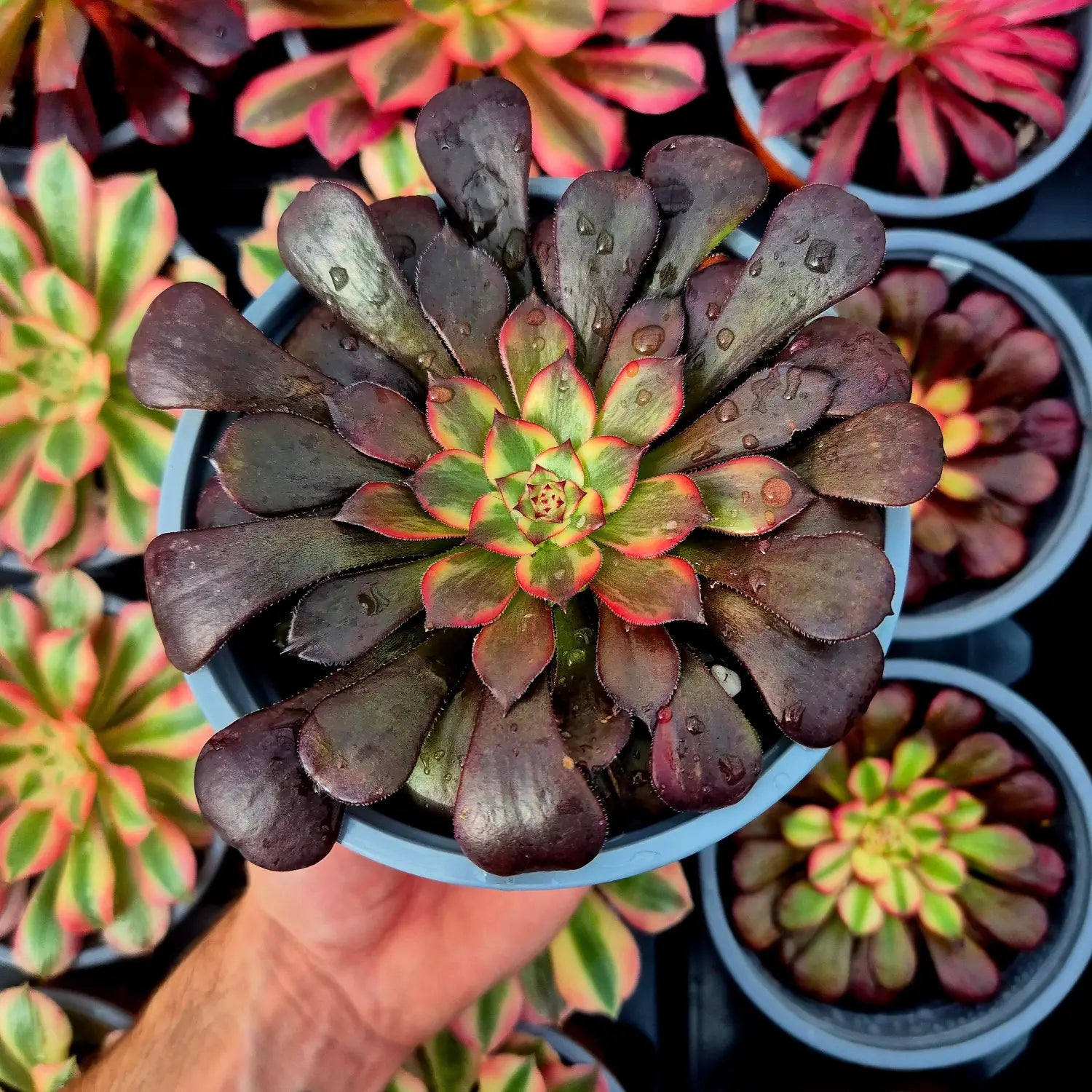
Lower energy production, slower growth
With less energy available, these plants prioritize:
- Maintaining existing tissues
- Surviving in variable conditions
- Reducing risks under stress
This translates into controlled growth, with leaves appearing more slowly and rosettes taking longer to open.
Variegated succulents prioritize stability over size
Unlike completely green succulents, variegated ones are not designed to grow quickly.
For this reason:
- They maintain compact forms
- They are more sensitive to excesses
- They react poorly to attempts to force growth
Excessive care often causes more problems than benefits.
Excess fertilizer does not accelerate growth
One of the most common mistakes is trying to compensate for slow growth with more fertilizer.
This can cause:
- Soft tissues
- Loss of compactness
- Less definition of the variegation
Fertilization should be gentle and timely, only during the active growth phase.
Dormancy is more evident in variegated plants
During winter or periods of intense heat, growth almost completely stops.
It is normal to observe:
- Closed rosettes
- Absence of new leaves
- Lower water consumption
This dormancy must be respected. Watering or fertilizing to "activate" the plant does not accelerate growth.
Reversion to green is an attempt to grow faster
When a variegated succulent produces completely green shoots, it is trying to increase its photosynthetic capacity.
These sprouts:
- Grow faster
- Produce more energy
- Can dominate the plant
If you want to maintain the variegation, they must be removed in time.
Proper light, not extreme
Good lighting promotes balanced growth, but intense sun does not accelerate development.
In variegated succulents:
- Excess sun causes stress
- Stress reduces growth
- Acclimatization is key
The right light helps maintain stability, not speed.
Slow growth is part of their value
Many of the most appreciated variegated succulents:
- They grow slowly
- They maintain their shape better
- They preserve stable patterns
Their measured pace is part of what makes them special and valuable.
Conclusion
The growth of variegated succulents is slower because these plants produce less energy, prioritize stability, and respond more sensitively to excesses. Respecting their natural pace is the best way to keep them healthy, compact, and long-lasting.
In our selection you will find:
Follow us on Instagram to stay updated on our latest news: