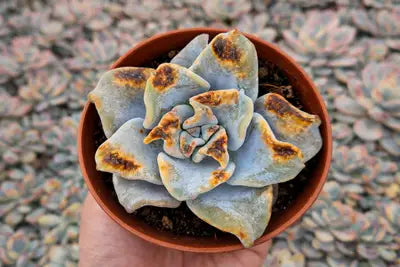
How to identify a stable variegated succulent: types of variegation and stability
Share
Introduction
Identifying a stable variegated succulent is essential to understand the true value of each plant.
Variegated succulents exhibit genetic mutations that alter the distribution of chlorophyll in the leaves. This alteration creates unique and highly valued color patterns in ornamental cultivation.
However, not all variegations exhibit the same degree of stability. Some maintain their pattern for years, while others may show changes during growth.
Understanding how these mutations work allows for the correct valuation of each plant and helps to explain why some specimens display more defined patterns than others.
What is variegation in succulents
Variegation is a genetic mutation that modifies the distribution of chlorophyll in the plant's tissues.
Areas with lower amounts of chlorophyll reflect different colors such as cream, yellow, pink, or white.
This mutation often forms cellular chimeras, where different types of cells coexist in the same tissue.
During growth, the balance between these cells can change. For this reason, some plants maintain very defined patterns while others may modify their appearance over time.
This behavior is a natural part of cultivating variegated succulents.
Types of variegation in succulents
There are different patterns of variegation. Some tend to be more stable than others.
Marginal variegation
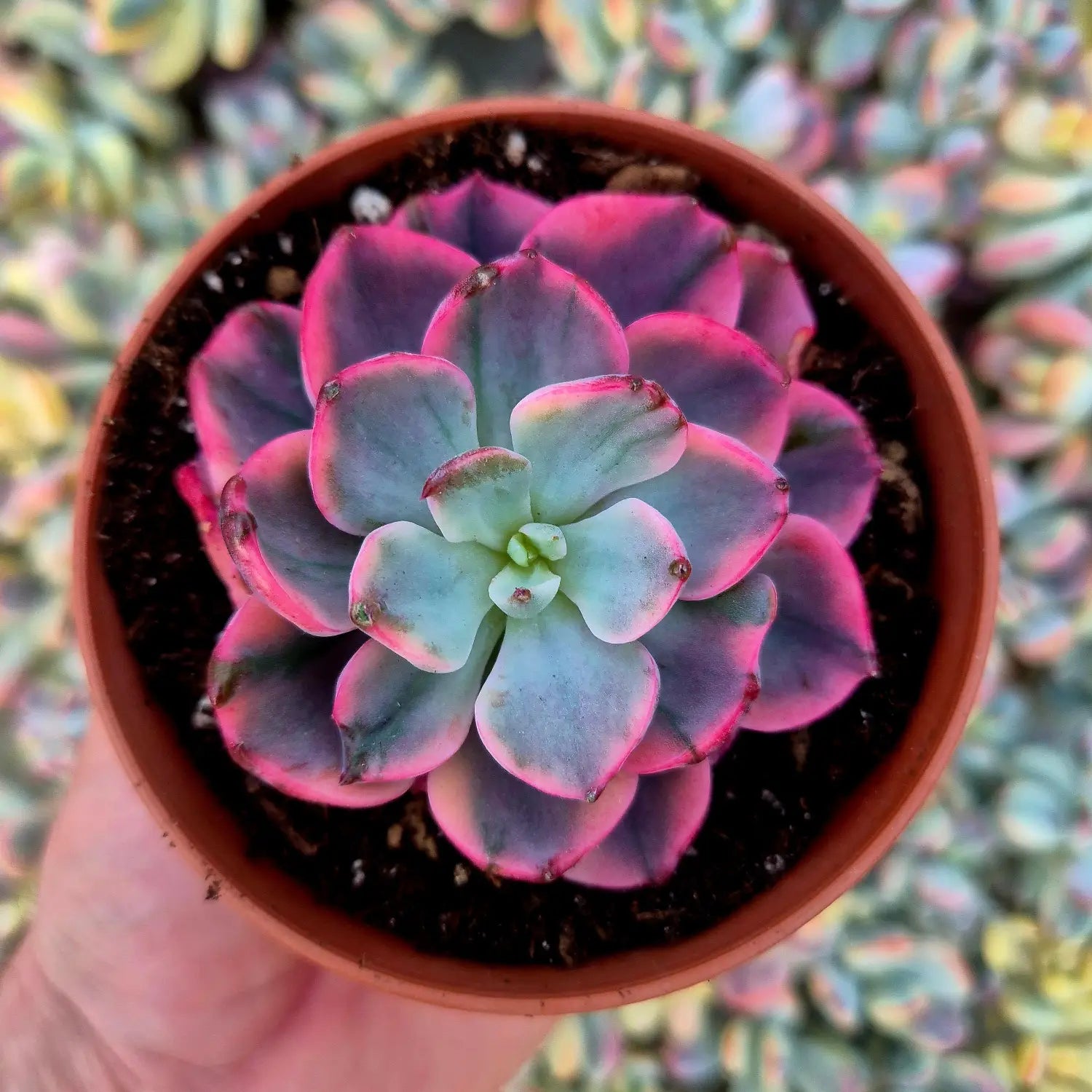
Marginal variegation occurs when the edge of the leaf has clear tissue while the center retains chlorophyll tissue.
This pattern tends to be quite stable because the photosynthetic tissue remains in the central area of the leaf.
Many commercial varieties exhibit this type of variegation.
Sectorial variegation
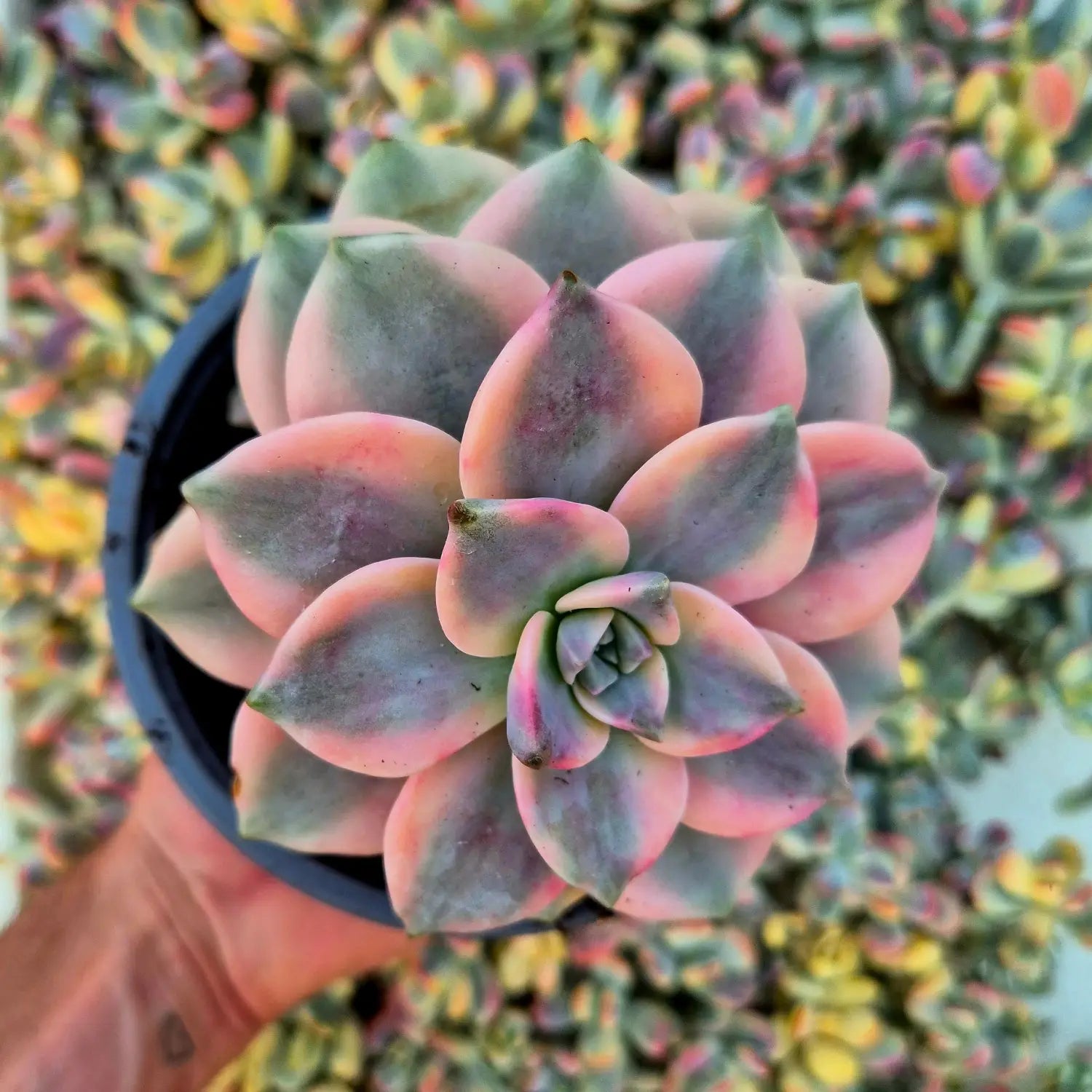
In sectorial variegation, one part of the leaf has chlorophyll tissue and another part shows variegated tissue.
The contrast is usually very pronounced and visually appealing.
In some cases, this pattern may change slightly between leaves, depending on how the tissue is distributed in the meristem.
Mottled variegation
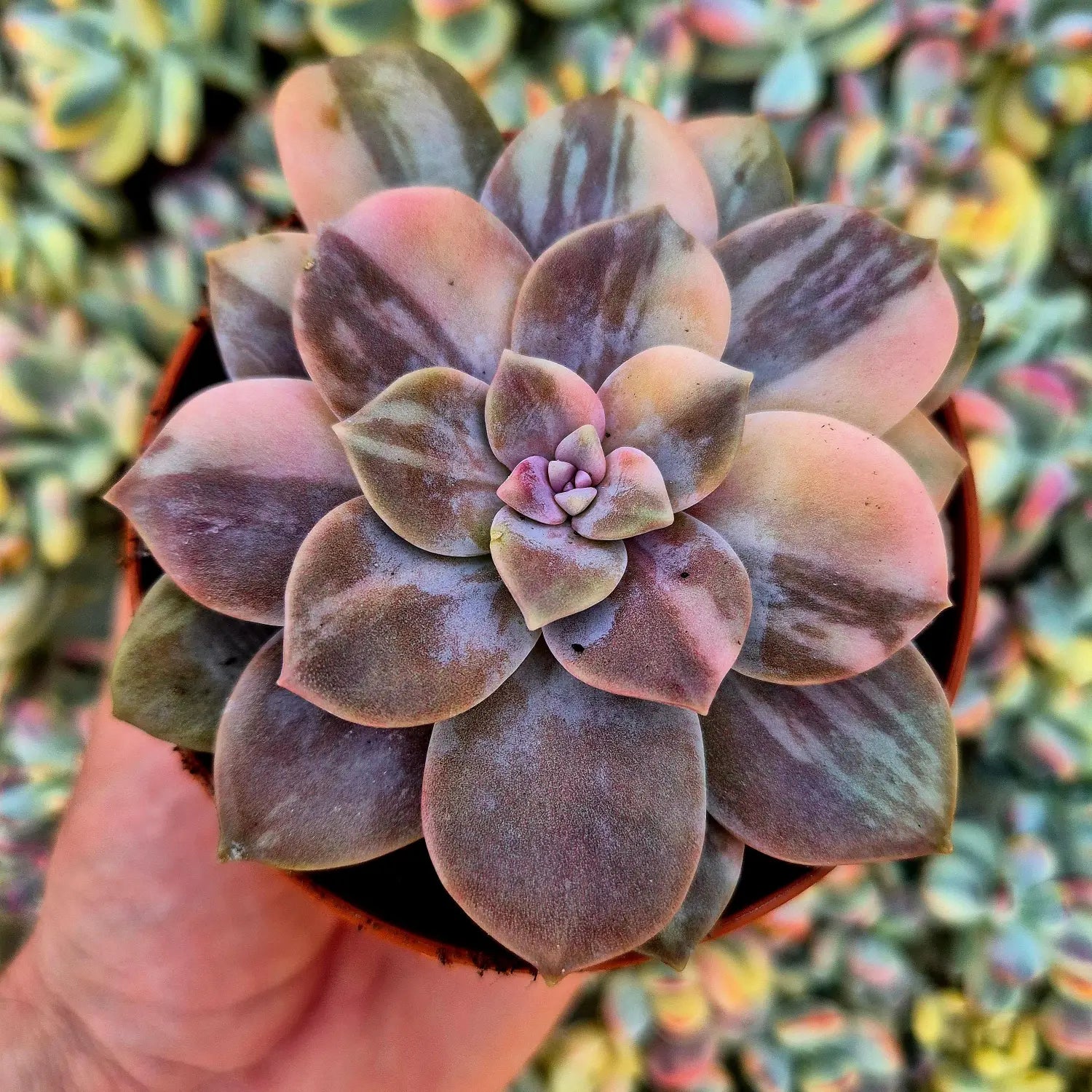
Mottled variegation appears as small light spots scattered across the leaf.
The pattern is usually more irregular than in other types of variegation.
Some plants maintain this appearance for years, while others may modify the pattern over time.
Albino variegation
In some cases, completely albino tissues appear, with no presence of chlorophyll.
These areas cannot perform photosynthesis and depend on the chlorophyll parts of the plant to survive.
When a rosette becomes completely albino, it usually cannot be sustained in the long term.
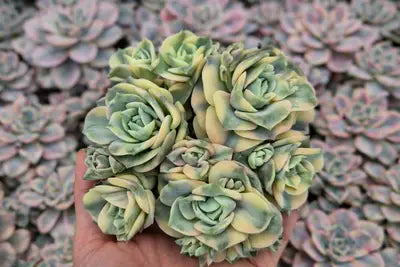
Golden variegation
Within the world of collecting, there is a particularly appreciated pattern known as golden variegation.
In this type of variegation, the pattern appears perfectly balanced between variegated tissue and photosynthetic tissue.
The leaves show very defined contrasts and the plant maintains a uniform aesthetic throughout the rosette.
This type of variegation is often considered the most stable and ornamental form within many species of variegated succulents.
How to identify a stable variegated succulent before buying it
There are several signs that help assess the stability of a variegated succulent.
Observe the pattern of the rosette
Stable plants often show a repeated variegation pattern across several leaves.
When the pattern appears consistently throughout the rosette, the mutation is usually better established.
If the variegation appears only on one leaf or in a small area, it may be a point mutation.
Review new growth
Recent growth provides a lot of information about the stability of the plant.
If the new leaves maintain the same pattern as the previous ones, the variegation is likely well established.
If the pattern changes constantly between leaves, stability may be lower.
Evaluate tissue balance
Variegated succulents need to maintain a certain balance between chlorophyll tissue and variegated tissue.
Plants that are too light often grow with greater difficulty.
Plants with too much chlorophyll tissue may lose some of the variegation over time.
Balanced variegations tend to be more stable in cultivation.
Check lateral shoots and offsets
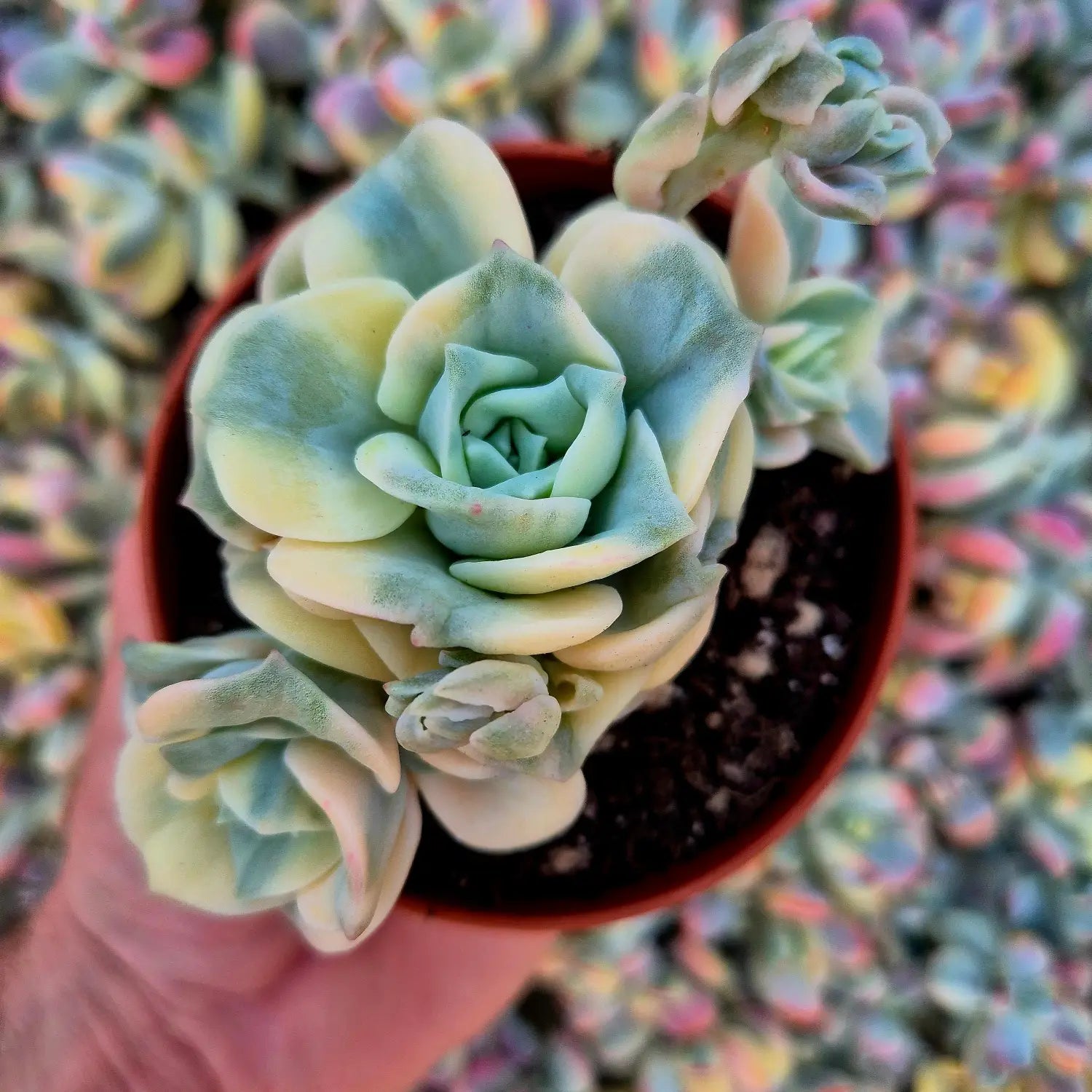
When the offsets present the same variegation pattern, it is a positive sign.
This indicates that the mutation is present in the main meristem of the plant.
If the lateral shoots show different patterns, stability may be lower.
Why do some plants present different patterns
In the cultivation of variegated succulents, it is normal to find plants with different levels of stability.
In the same production, specimens with very defined patterns and others with more irregular variegations can appear.
Plants with perfectly balanced patterns are usually more valued in the ornamental market.
However, plants with less stable variegations can also be very interesting for growers who enjoy observing how the plant evolves over time.
Working with this type of specimen allows for experimentation with corrective pruning, selection of shoots, and evolution of the variegation pattern.
The value of each plant in the market
In professional cultivation, the stability and aesthetics of the pattern directly influence the value of the plant.
Succulents with well-defined and balanced variegations tend to reach higher prices.
In contrast, specimens with less uniform patterns may be offered at more accessible prices.
This allows different types of growers to enjoy these plants, from collectors seeking perfect patterns to enthusiasts interested in experimenting with their evolution.
Even a plant with unstable variegation can provide months or years of enjoyment while observing its development.
Conclusion
Variegation is one of the most fascinating phenomena in the cultivation of succulents.
Understanding the different types of variegation and learning to observe the stability of each plant allows for a better appreciation of each specimen.
Some plants exhibit perfectly balanced patterns from the start, while others evolve over time.
Both situations are part of the genetic diversity that makes the cultivation of variegated succulents so interesting.
Learn to cultivate variegated succulents step by step
If you want to delve into all the essential care —substrate, watering, light, pot, or stability of the variegation— we recommend our complete cultivation guide:
If you want to expand your collection and propagate variegated succulents, you can explore our variegated succulents, as well as variegated aeoniums, rare succulents, and classic variegated selections for collectors.
{"id":"Avada-Tool__RelatedBlogs-2","posts":[{"id":"gid://shopify/Article/612906664274","title":"Suculentas variegadas: guía de cultivo y cuidados esenciales","imageUrl":"https://cdn.shopify.com/s/files/1/0945/4288/9298/articles/guia-cultivo-echeverias-variegadas_159fe2a6-f769-4763-a5fc-258ee88e16a1.png?v=1771876017&width=400","imageAlt":"Conjunto de Echeverias variegadas con distintos patrones de variegación en cultivo","handle":"suculentas-variegadas-guia-cultivo","blogTitle":"Blog","blogHandle":"noticias","publishedAt":"2026-02-12T22:20:02Z","summary":"
En esta guía completa sobre suculentas variegadas repasamos los cuidados esenciales para su correcto desarrollo: desde la aclimatación inicial hasta el riego por inmersión, el sustrato ideal, el tamaño de maceta o la estabilidad de la variegación. Un enfoque práctico orientado a cultivadores que buscan plantas sanas, compactas y con patrones de color estables a largo plazo.
","postUrl":"https://www.donsuculentas.com/blogs/noticias/suculentas-variegadas-guia-cultivo"}, {"id":"gid://shopify/Article/610142912850","title":"Suculentas variegadas: cuidados y reproducción","imageUrl":"https://cdn.shopify.com/s/files/1/0945/4288/9298/articles/cuidados-basicos-suculentas-variegadas-reproduccion_f99ad440-07f9-4fbe-bbca-3f7771396290.png?v=1771878578&width=400","imageAlt":"Suculentas variegadas con múltiples rosetas tras reproducción por corte","handle":"suculentas-variegadas-cuidados","blogTitle":"Blog","blogHandle":"noticias","publishedAt":"2025-03-06T16:55:00Z","summary":"
Las suculentas variegadas destacan por sus colores únicos y su rareza, convirtiéndolas en auténticas joyas para coleccionistas. Descubre qué es la variegación, sus tipos (natural e inducida), cómo cuidarlas correctamente y los mejores métodos de propagación para conservar su belleza. Aprende a mantener su coloración y evitar que reviertan a su forma original. ¡Conviértete en un experto en suculentas variegadas con Don Suculentas!
","postUrl":"https://www.donsuculentas.com/blogs/noticias/suculentas-variegadas-cuidados"}, {"id":"gid://shopify/Article/613207703890","title":"Reversión y albinismo en suculentas variegadas: causas y cómo controlarlos","imageUrl":"https://cdn.shopify.com/s/files/1/0945/4288/9298/articles/reversion-albinismo-suculentas-variegadas_2af8d8d1-e2fa-42b3-bf7c-27a6b649e94a.png?v=1772642523&width=400","imageAlt":"reversión y albinismo en suculenta variegada ejemplo de variegación inestable","handle":"reversion-albinismo-suculentas-variegadas","blogTitle":"Blog","blogHandle":"noticias","publishedAt":"2026-03-20T09:00:00Z","summary":"
La reversión y el albinismo son dos fenómenos comunes en suculentas variegadas. Aprende por qué aparecen y cómo actuar cuando afectan a la roseta principal.
","postUrl":"https://www.donsuculentas.com/blogs/noticias/reversion-albinismo-suculentas-variegadas"}, {"id":"gid://shopify/Article/612746035538","title":"Guía lunar para suculentas: cuándo regar, abonar, trasplantar y hacer esquejes","imageUrl":"https://cdn.shopify.com/s/files/1/0945/4288/9298/articles/guia-lunar-cultivo-suculentas-variegadas_9dcaaea3-7ebd-4865-9840-971732d7c355.png?v=1771874797&width=400","imageAlt":"Suculenta variegada en exterior nocturno representando el cultivo según ciclo lunar","handle":"guia-lunar-suculentas-variegadas","blogTitle":"Blog","blogHandle":"noticias","publishedAt":"2026-02-09T09:00:06Z","summary":"
Las cuatro fases principales de la luna —luna nueva, cuarto creciente, luna llena y cuarto menguante— marcan distintos ritmos de actividad en las plantas. En el cultivo de suculentas, conocer estas fases nos permite elegir mejor cuándo regar, trasplantar, hacer esquejes o aplicar tratamientos, reduciendo riesgos y respetando el ciclo natural de la planta.
","postUrl":"https://www.donsuculentas.com/blogs/noticias/guia-lunar-suculentas-variegadas"}, {"id":"gid://shopify/Article/610209071442","title":"Cómo lograr suculentas más coloridas: técnicas y cuidados esenciales","imageUrl":"https://cdn.shopify.com/s/files/1/0945/4288/9298/articles/como-lograr-suculentas-mas-coloridas_eb525ca7-5552-40f2-8e07-6361b9ea933b.png?v=1771878134&width=400","imageAlt":"Suculentas variegadas con colores intensos tras exposición controlada al sol","handle":"suculentas-coloridas-tecnicas","blogTitle":"Blog","blogHandle":"noticias","publishedAt":"2025-03-16T16:54:36Z","summary":"
Descubre cómo lograr suculentas vibrantes y coloridas mediante técnicas de estrés hídrico, solar y químico. Aprende a dominar estos métodos para realzar la belleza natural de tus plantas y obtener resultados sorprendentes. Conoce los factores esenciales que influyen en la intensidad de sus colores y cómo aplicarlos de manera efectiva.
","postUrl":"https://www.donsuculentas.com/blogs/noticias/suculentas-coloridas-tecnicas"}, {"id":"gid://shopify/Article/612747641170","title":"10 Errores comunes en el cuidado de suculentas variegadas | Guía práctica","imageUrl":"https://cdn.shopify.com/s/files/1/0945/4288/9298/articles/errores-cuidado-suculentas-variegadas-quemadura-solar_b8c3053a-95b7-4b7b-9dd2-82c5d4c7736c.png?v=1771877704&width=400","imageAlt":"Suculenta variegada con quemaduras solares visibles en las hojas","handle":"errores-suculentas-variegadas","blogTitle":"Blog","blogHandle":"noticias","publishedAt":"2026-02-16T00:32:00Z","summary":"
Las suculentas variegadas requieren cuidados específicos y pequeños errores pueden afectar seriamente a su salud. En este artículo repasamos los errores más comunes y cómo evitarlos para mantener plantas sanas y estables.
In this comprehensive guide to variegated succulents, we review the essential care for their proper development: from initial acclimatization to immersion watering, the ideal substrate, pot size, or the stability of variegation.A practical approach aimed at growers seeking healthy, compact plants with stable long-term color patterns.
Variegated succulents stand out for their unique colors and rarity, making them true gems for collectors. Discover what variegation is, its types (natural and induced), how to care for them properly, and the best propagation methods to preserve their beauty. Learn how to maintain their coloration and prevent them from reverting to their original form.Become an expert in variegated succulents with Don Suculentas!
The four main phases of the moon —new moon, first quarter, full moon, and last quarter— mark different rhythms of activity in plants. In the cultivation of succulents, knowing these phases allows us to better choose when to water, transplant, take cuttings, or apply treatments, reducing risks and respecting the natural cycle of the plant.
Discover how to achieve vibrant and colorful succulents through techniques of water, solar, and chemical stress. Learn to master these methods to enhance the natural beauty of your plants and achieve stunning results. Understand the essential factors that influence the intensity of their colors and how to apply them effectively.
Variegated succulents require specific care, and small mistakes can seriously affect their health. In this article, we review the most common mistakes and how to avoid them to keep plants healthy and stable.