

Price of variegated succulents: why some plants cost so much
Variegated succulents have quickly transitioned from a very niche category to one of the most popular categories within plant collecting in just a few years. This has also brought about debates regarding their prices. Does it make sense to pay high amounts for a single plant? Why do some varieties cost tens or even hundreds of euros?
Although we are professionally dedicated to this sector, our general response is quite clear: it is usually not worth paying excessively high prices for a plant that has just come onto the market.
And not because they are not spectacular plants, but because we are talking about living beings, an extremely volatile market, and varieties whose prices tend to drop rapidly over the months.
Before purchasing a very expensive plant, it is advisable to understand how this market really works.
Why variegated succulents are so expensive
Variegated succulents are not mass-produced plants like many traditional ornamental plants.
Most new varieties come from Asia, especially from China, Korea, Indonesia, or Thailand. In many cases, we are talking about plants that are still not widely reproduced, with limited production and very high demand among collectors.
Additionally, the process of creating and selecting new varieties is slow and costly. Many mutations appear spontaneously and must be stabilized for years before reaching the market. Others require multiple hybridizations, selection of specimens, and long cultivation periods to verify if the variegation or mutation remains stable.
When a new variety appears on the market, the first available units often reach very high prices simply because there are still very few specimens circulating outside the producing country.
Here the basic law of supply and demand comes into play.
- There are few plants available
- Many people want to get them
- The price skyrockets
However, this process usually lasts a short time.
The succulent market changes very quickly
One of the most important aspects that many people are unaware of is the speed at which the market for variegated succulents evolves.
Currently, Asian producers are constantly generating new products.Every few months, new mutations, hybrids, or commercial selections appear that quickly replace previous varieties.
This causes many plants to go from being extremely exclusive to becoming relatively accessible in a very short time.
It is not uncommon to see varieties that initially hit the market for 300 or 400 dollars and that, a year later, can be found for a fraction of that price.
The price drop of variegated succulents is usually much faster than most people imagine.
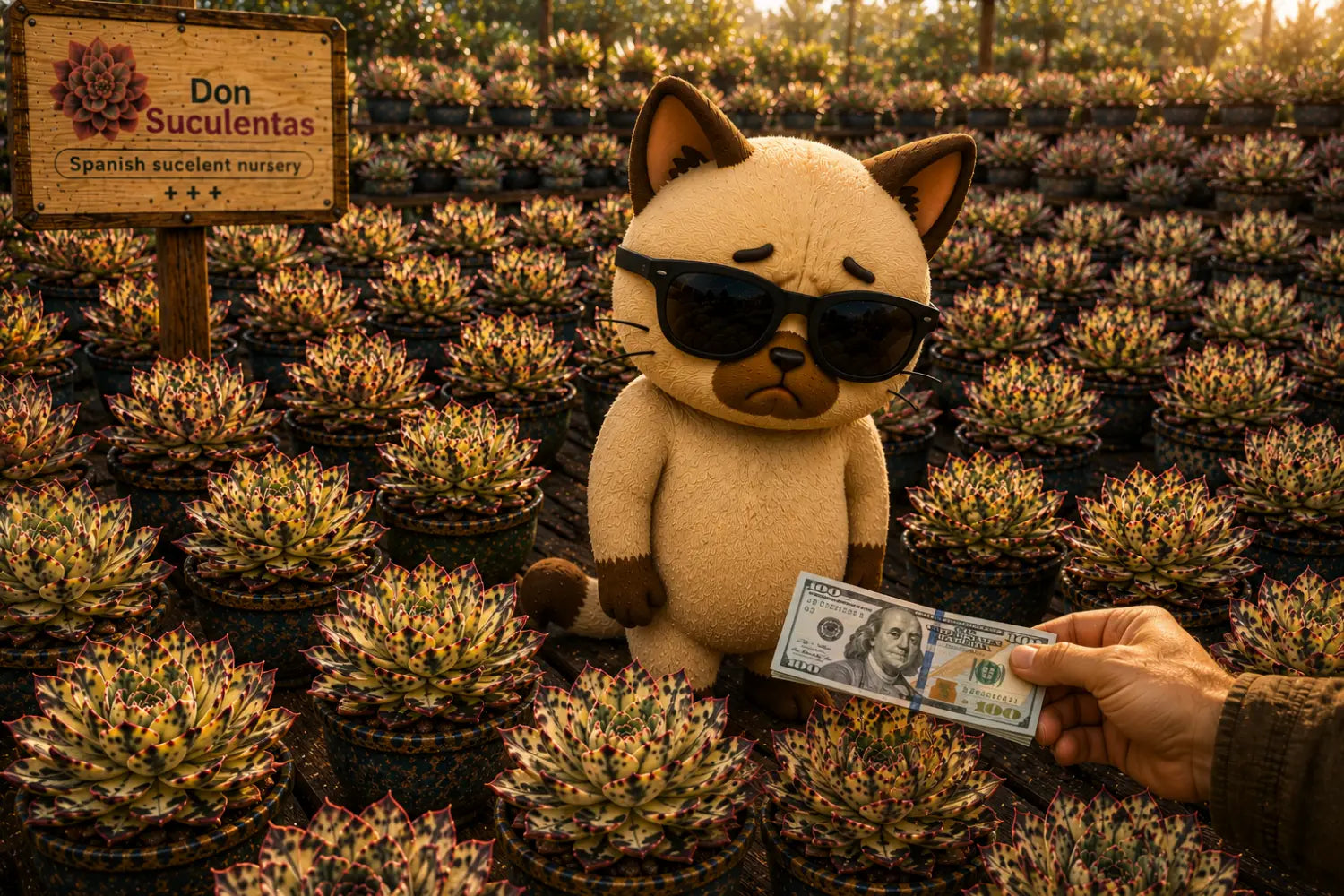
What really increases the cost of an imported plant
Many times we see advertisements using terms like:
- “Korean succulent”
- “Echeveria Korea”
- “Aeonium Korea”
Sometimes it is simply used as a commercial lure. Other times we are indeed talking about imported plants that are still not available locally.
When an import is legitimate, the final cost of the plant does not depend solely on the price at origin.
Importing plants involves many additional expenses.
- International shipping
- Phytosanitary certificate
- Phytosanitary inspection at destination
- Customs agent
- VAT on plants
- VAT on transportation
- Import duties
All of this means that a plant that costs 5 dollars at origin can easily double its price upon arriving in Europe.
And to be honest, if you see a plant advertised as “import” at 5 €, you should probably be suspicious. In most cases, the costs associated with a real import make it very difficult to maintain such low prices without sacrificing quality, size, or stability of the plant.
Why importing few plants is much more expensive
In small imports, fixed costs are spread over very few units.
For example, in reduced orders of about 80 to 120 plants, the added cost can easily range from 5 to 8 euros per plant solely in import expenses.
In larger imports, of 400 or 600 plants, those same expenses are distributed among many more units and the added cost per plant decreases significantly.
That is why many producers or large stores can offer better prices than small occasional sellers.
Long trips also affect the price
Another important factor is transportation times.
From the moment a plant is purchased until it finally arrives at the destination nursery, it can easily take between four and six weeks.
And during international transport, plants usually remain traveling for approximately 7 to 14 days.
When everything works correctly and the plants arrive in a week, the condition is usually good. But when delays occur in flights, customs, or phytosanitary inspections, some plants arrive very deteriorated or are lost altogether.
These losses also end up affecting the final price of the plants that survive.
Reproduction has completely changed the market
A few years ago, many rare varieties multiplied slowly and availability was very limited.
Currently, many Asian producers use techniques such as grafting to greatly accelerate production and reduce cultivation times.
This has completely changed the market.
- More plants are produced
- New products last less time
- Prices drop much faster
What used to take years to become popular can now multiply massively in just a few months.
Is it worth paying very high prices?
It completely depends on the economic situation and how each person experiences this hobby.
But being realistic, in most cases probably not.
Many people buy very expensive new products on impulse and find out months later that the same plant costs half.
In such a fast-paced market, paying very high amounts only makes sense in some cases:
- Highly specialized collectors with high purchasing power
- People who want to enjoy a novelty before anyone else
- Plants that are really difficult to reproduce
- Exceptional or very mature specimens
When it does make sense to pay more for a plant
There is an important difference between paying for novelty and paying for cultivation time.
A variegated Aeonium with five years of development and more than twenty heads cannot be worth the same as a young specimen with a single rosette.
Similarly, some plants have extremely slow growth rates or exhibit unstable variegations that make their production very difficult.
Not all succulents reproduce at the same rate.
Some examples are:
- Some
- Sedum like ‘Joyce Tulloch’ can grow much faster and reproduce with great ease
In these cases, it makes sense that there are significant price differences between varieties.
The true value of this hobby
Over time, many collectors end up discovering that the most interesting aspect of this hobby is not always having the latest novelty on the market.
What is truly special is often seeing how the plants grow, adapt, form colonies, produce offsets, or evolve over years of cultivation.
Succulents are living beings. And precisely for that reason, many times the most enjoyed plants are not necessarily the most expensive.
Learn to cultivate variegated succulents step by step
If you want to delve into all the essential care —substrate, watering, light, pot, or stability of the variegation— we recommend our complete cultivation guide:
If you want to expand your collection and propagate variegated succulents, you can explore our variegated succulents, as well as variegated aeoniums, rare succulents, and classic variegated selections for collectors.
Follow us on Instagram to see new arrivals and restocks:

- Choosing a selection results in a full page refresh.
- Opens in a new window.