How Echeverias, Aeonium, and modern succulents were born
When we talk about succulents, many people imagine a large and generic group of resilient plants. But the commercial reality is very different. The modern collecting market is primarily supported by a few very specific genera. And in this article, we are going to talk especially about the genera that we like the most and work with within modern collecting: - Echeveria - Graptopetalum - Pachyphytum - Aeonium Interestingly, although they coexist today in thousands of collections around the world, their evolutionary histories are quite different.While Echeveria, Graptopetalum, and Pachyphytum evolved mainly in Mexico and nearby regions of North America…
The Aeonium did so in the Macaronesian region of the Atlantic. And that is really where the story of modern succulents begins.
Mexico and the origin of Echeverias
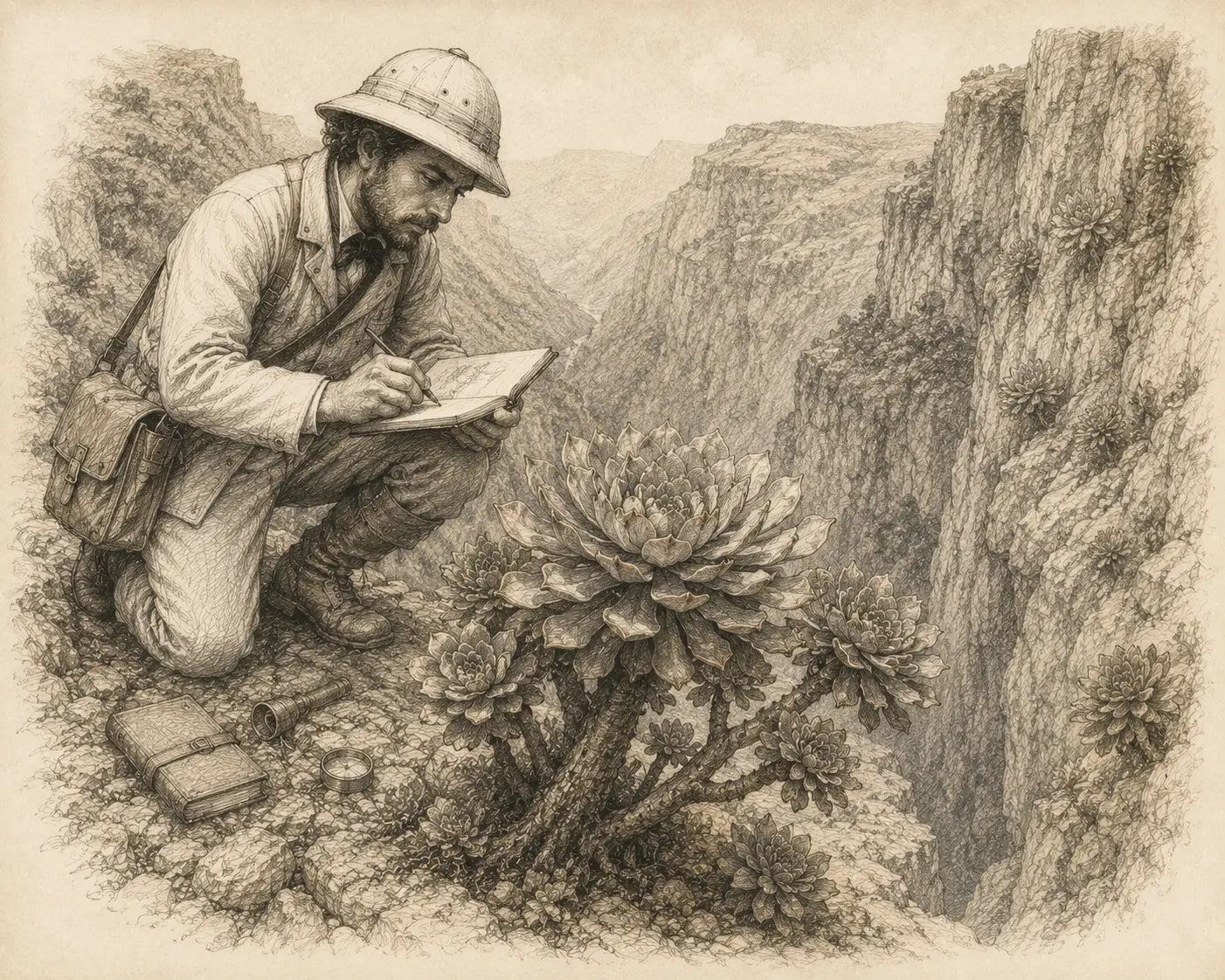
Echeverias did not originate in nurseries. Neither in Korea nor in California. They were born growing wild among ravines, rocky walls, arid mountains, volcanic areas, dry cliffs, and valleys.
Mexico represents the world's main center of diversity for Echeveria, Graptopetalum, and Pachyphytum, although many related species and genera also appear in bordering regions of North America and Central America.
The enormous variety of altitudes, climates, volcanic soils, arid zones, and mountain ranges favored the evolution of hundreds of different forms of Crassulaceae over millions of years.
Many species grew practically without substrate, enduring long droughts, extreme radiation, abrupt temperature changes, and very aggressive conditions.
And although today we associate Echeverias with pastel colors, perfect rosettes, and compact hybrids, most original botanical species were much more variable and less visually "perfect" than many modern hybrids.
How the Echeveria genus was born
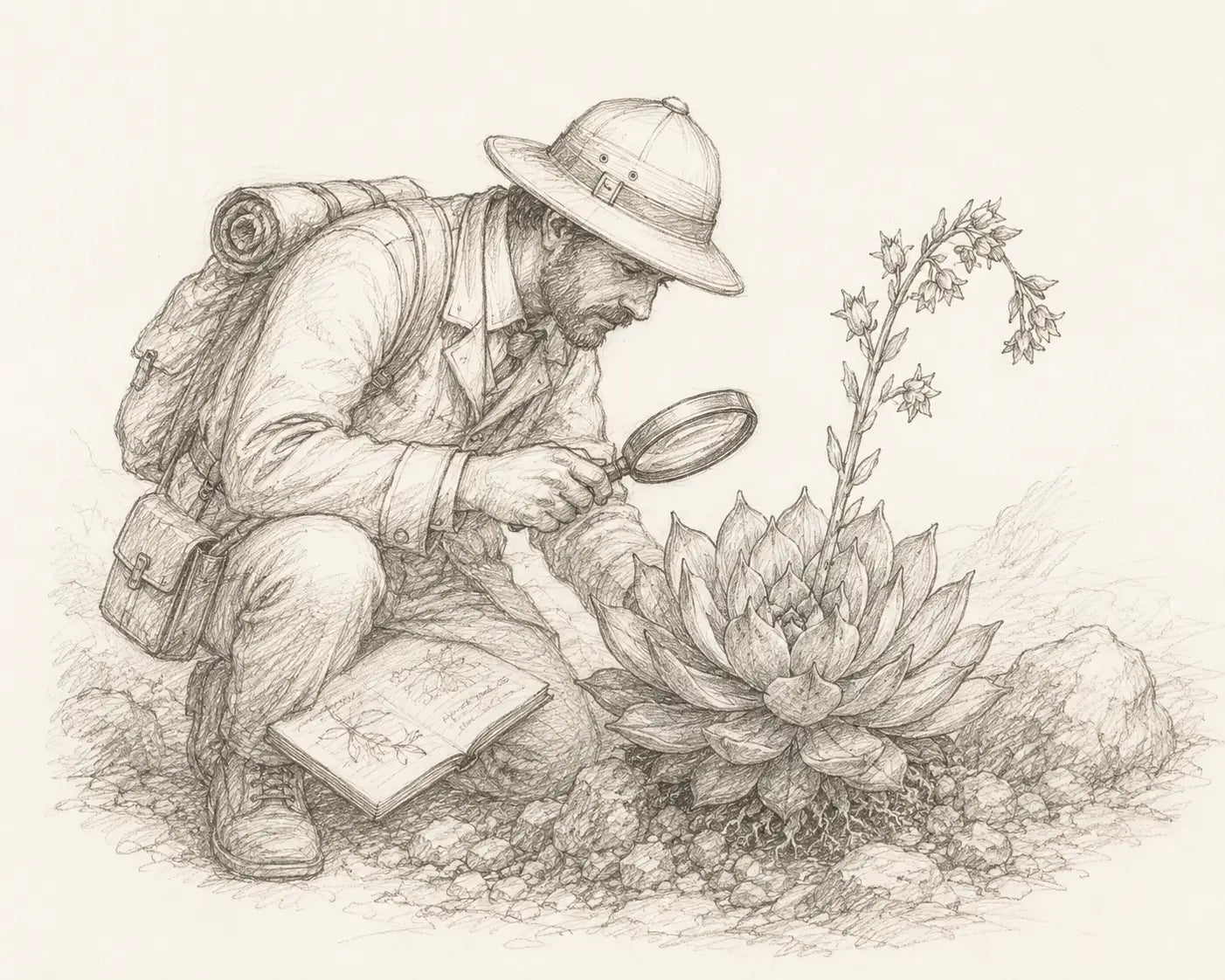
Everything began to change during the botanical expeditions of the late 18th and early 19th centuries.Europe was obsessed with cataloging new species, and Mexico quickly became one of the most interesting territories in the world due to its biodiversity.
In 1828, the Swiss botanist Augustin Pyramus de Candolle officially describes the genus Echeveria. The name was chosen in honor of Atanasio Echeverría y Godoy, a Mexican botanical illustrator who participated in the documentation of the flora of New Spain.
Yes. The Echeverias are named after an illustrator, not a nurseryman or a botanist.
Pachyphytum and the impossible leaves
Shortly after, another extremely striking group begins to be described: the Pachyphytum.
The genus was officially established in 1841 and quickly attracted a lot of attention due to a very specific characteristic. Its leaves looked almost artificial.
Many species developed globose leaves, extremely intense pruina, rounded shapes, and soft grayish or pinkish colors.
Even today, many species of Pachyphytum still look like unreal plants.
Decades later, they would be fundamental in creating Pachyverias, ultra-compact hybrids and extremely fleshy modern lines.
Graptopetalum and the beginning of modern hybrids
Graptopetalum would arrive somewhat later. It was officially described in 1911 by Joseph Nelson Rose.
And here we begin to enter a different stage. Mexico was starting to be explored much more, and modern herbaria, constant expeditions, international exchange of species, and specialized botanical societies already existed.
American and European collectors were completely fascinated with the Mexican Crassulaceae.
And Graptopetalum began to stand out for its soft colors, rapid growth, ease of reproduction, and great ability to hybridize.
Something very important to understand the modern market.
Because this is probably where part of the genetic base was born that decades later would allow the creation of Graptoverias, Graptosedum, and modern complex hybrids.
The boundaries between genera have never been entirely clear.
And here something very curious appears.
Although today we talk about Echeveria, Graptopetalum, and Pachyphytum as completely separate genera, the reality is that many botanists have been discussing for decades where one truly ends and the other begins.
They share many characteristics such as floral structure, growth forms, genetic compatibility, and ease of hybridization.
And honestly… that perfectly explains why there are so many intergeneric hybrids today.
Many of the most famous modern plants probably could not exist if these genera were not so evolutionarily related.
Meanwhile, the Aeonium were evolving in Macaronesia
While the Mexican Crassulaceae were evolving in North America, the Aeonium were primarily evolving in the Macaronesian region.
That is:
- Canary Islands
- Madeira
- Northern regions of Morocco
- Other nearby Atlantic territories
Although the Canary Islands concentrate the greatest diversity of species, Aeonium are not exclusive to the islands.
And precisely that partial isolation between archipelagos and coastal areas was one of the factors that favored the enormous diversity of the genus.
Over time, tree species, giant rosettes, hanging forms, dark colors, and extremely variegated structures appeared.
Each island and each microclimate ended up generating its own characteristics.
The Aeonium confused the early botanists.
For a long time, the Aeonium did not even have its own genus.
Many species were initially classified within Sempervivum, simply because early botanists grouped practically all succulent rosettes within the same groups.
But little by little it began to be seen that the Macaronesian species were completely different.
They developed woody stems, shrubby growth, inverted cycles, much larger sizes, and Atlantic adaptation.
Finally, the genus Aeonium was officially established in 1840.
And since then, Macaronesia has become one of the most fascinating places in the world to study plant evolution.
One of the most spectacular evolutionary processes in the plant world
The most interesting thing about Aeonium is that practically all modern species derive from a common ancestor.
That ancestor arrived on the islands, and isolation did the rest.
Over time, tree species, giant rosettes, hanging forms, dark colors, and extremely variable structures appeared.
Each island ended up developing its own characteristics.
And even today, the Canary Islands continue to be the world's main center of Aeonium diversity.
For decades, they were simply botanical rarities.
Although many species had already been described, for much of the 19th century and the early 20th century, these plants remained primarily scientific curiosities, collector's plants, and species exchanged among enthusiasts.
There was still no mass production, modern hybridization, or extreme ornamental selection.
Plants were primarily valued for their botanical rarity, geographical origin, and scientific interest.
Not for aesthetics.
That would completely change decades later.
The beginning of the ornamental revolution
In the mid-20th century, some American nurserymen began to realize something revolutionary.
These plants were not only botanically interesting. They could also become ornamental plants, decorative hybrids, and commercial products.
And that is where the modern market for succulents truly begins.
Because while Mexico had provided the species… California was about to create the first hybrids that would forever transform the collection of Echeverias and ornamental Crassulaceae.
The history of modern succulents
Modern succulents did not emerge overnight. Behind the compact Echeverias, the
In this series, we explore how Mexico, California, Korea, Europe, and China changed the global market for modern Crassulaceae and the collection of variegated succulents.
Many of the data, stories, and connections we share here stem from our own experience within the industry, years of observing market evolution, and conversations with collectors and international producers. Some parts of the modern history of succulents are not fully documented, and there are sometimes different versions regarding certain hybrids, dates, or origins.
If you detect any incorrect information or want to provide additional information about this market evolution, we would be happy to hear from you and continue expanding this series.
Learn to cultivate variegated succulents step by step
If you want to delve into all the essential care —substrate, watering, light, pot, or stability of the variegation— we recommend our complete cultivation guide:
If you want to expand your collection, you can explore our variegated succulents, as well as variegated aeoniums, rare succulents and classic variegated selected for collectors.
Follow us on Instagram to see new arrivals and restocks: