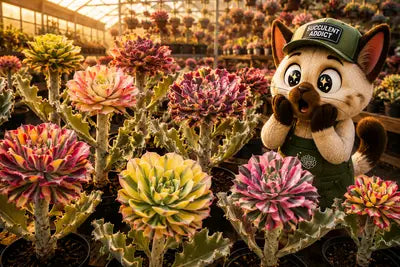
Europe and the modern boom of succulents
How Holland and Spain Transformed the European Market
While Korea was revolutionizing the modern aesthetic of Echeverias, Europe was building something completely different. Production, distribution, logistics, and commercial adaptation of the ornamental market.
And although much more is often said about Korea or California, a large part of the real expansion of modern collecting in Europe cannot be understood without the role of Holland and Spain. Especially between 2015 and 2020, likely having the pandemic as the peak point of market explosion.
Holland and the Professionalization of the Ornamental Market
Long before the succulent boom, Holland was already a true global powerhouse in ornamental horticulture.They dominated greenhouses, automation, plant logistics, and a good part of the international distribution of ornamental plants in Europe.
So it was only a matter of time before they fully entered the Crassulaceae.
Holland did not initially revolutionize genetics as had happened in California or Korea. But it did revolutionize something equally important: European distribution.
While California was creating hybrids and Korea was redefining modern aesthetics, Dutch nurseries began to import genetics, mass-produce it, and redistribute it throughout Europe. And that was key for succulents to definitively stop being an exclusively niche product.
Ubink and the expansion of succulents in Europe
One of the most important historical names of this stage was Ubink Cactus & Succulent.
Here the goal was no longer solely collecting or rarity. The market begins to fully professionalize. Stable production, homogeneous sizes, efficient logistics, and adaptation to ornamental retail.
And honestly, a large part of the succulents that arrived in Europe over the years passed directly or indirectly through Dutch nurseries.
Plants gradually begin to enter garden centers, large surfaces, and ornamental distribution chains. Succulents are no longer seen solely as rare collector's plants and begin to become a mass ornamental product.
While Korea was revolutionizing Instagram
And here something very interesting happens.
During those same years, Korea was completely revolutionizing the visual aesthetic of the global market. Ultra compact rosettes, unreal colors, premium hybrids, and almost perfect plants for photography began to dominate Instagram and collector groups.
Europe gradually began to absorb all that influence. Especially between 2015 and 2020, probably never before had so many Asian succulents circulated within the European market. And that completely changes the taste of the Western collector.
Plants no longer had to be just resilient or beautiful: they had to look perfect.
The pandemic completely accelerated the market
And honestly, here probably comes the great modern turning point of the European market: the pandemic.
During those years, a lot of people start spending more time at home and the interest in plants completely explodes. Especially indoor plants, aroids, succulents, variegated plants, and premium hybrids.
Collecting accelerates significantly. Imports increase, prices rise, and huge amounts of Asian genetics begin to circulate throughout Europe.
Many plants that were previously extremely difficult to obtain start to gradually appear in European nurseries much more regularly.
Spain and the advantage of the Mediterranean climate
But while Holland dominated much of the logistics and distribution, Spain had an even more important advantage: The climate.
Especially for cultivating Echeveria, Graptopetalum, Pachyphytum, and Aeonium. Plenty of light, mild winters, and much lower costs than much of Northern Europe.
And little by little, Spain begins to build a gigantic production, especially in Mediterranean areas with perfect conditions for mass cultivation.
Cactus Serrano and modern European production
Here appears one of the most important names on the continent: Cactus Serrano.
Probably one of the largest producers and distributors of succulents in the world. Here we are talking about enormous production, international import, massive multiplication, and continental distribution fully adapted to the modern European market.
But there is something important. Cactus Serrano not only helped to expand the European market. They also ended up participating in the development of new ornamental lines through selection and large-scale production.
Although they do not operate as classic breeders in the Korean style, they do work with enormous seedbeds and selection processes where particularly interesting plants occasionally appear.
One of the most well-known examples is probably Echeveria ‘Madiba’, a plant directly associated with Cactus Serrano and which ended up becoming one of the most recognizable European hybrids in recent years.
And honestly, this marks something important. Europe was no longer just reproducing foreign genetics. It was also slowly starting to reinterpret it.
Giromagi and the new European distribution
And if we talk about the modern European market, we also have to mention Giromagi. Probably one of the major current distributors of succulents in Europe.
Especially because they understood very well something fundamental about the modern market: plants are no longer sold solely for rarity or collection. They are also sold as a complete visual product.
Giromagi developed a very careful image around its plants, with well-designed packaging, modern presentation, and a very strong distribution aimed at both collectors and the general public.
And that allowed them to enter with great strength into:
- Garden centers
- Large retail spaces
- Modern ornamental retail
- European online distribution
In many aspects, they perfectly represent the evolution of the European market towards a much more professionalized, visual model adapted to the modern consumer.
The boom of the Aeonium variegados
Especially during those years, the
The first plants that really started to circulate relatively massively were hybrids and selections like Mardi Gras, Emerald Ice, Sunburst, or Starburst. Very visual plants, with strong contrasts and a completely different aesthetic from the classic image that many people had of Aeonium.
And little by little, collectors began to look at this genus in a different way. Aeonium were no longer seen solely as large outdoor plants or resilient landscape species.
They also began to become premium plants and ornamental collector's pieces.But the great turning point comes later:
Aeonium ‘Medusa’ appears as a natural mutation in the Netherlands and quickly draws a lot of attention for its extreme variegation, pink tones, and a completely different aesthetic from any Aeonium known until that moment.
Visually it looked like something else. And that’s when the market completely changes.
The plant ends up being exported to China, and once the Chinese industry detects the commercial potential of the
New mutations begin to appear, multicolored lines, increasingly extreme hybrids, and a new generation of Aeonium designed directly for modern visual collecting.
And this is probably where the global revolution of premium
Continue exploring the history of modern succulents
The modern boom of succulents cannot be understood without the influence of Europe. While Korea revolutionized the aesthetics of compact Echeverias, Europe professionalized much of the production, distribution, and expansion of modern collecting.
In this series, we explore how California, Korea, Europe, and China transformed the international market for modern Crassulaceae and variegated succulents.
Many of the data, stories, and connections we share here stem from our own experience within the industry, years of observing market evolution, and conversations with collectors and international producers.Some parts of the modern history of succulents are not completely documented, and there are sometimes different versions regarding certain hybrids, dates, or origins.
If you detect any incorrect information or want to provide additional information about this market evolution, we would be happy to hear from you and continue expanding this series.
If you want to expand your collection, you can explore our variegated succulents, as well as variegated aeonium, rare succulents and classic variegated selected for collectors.
Follow us on Instagram to see new arrivals and restocks: