How Korea reinvented Echeverias
The revolution that forever changed the succulent market
For decades, California completely dominated the market for ornamental hybrids. American nurserymen had created the first giant Echeverias, wavy hybrids, pastel colors, and much more spectacular shapes than the original botanical species.
But in the early 2000s, a new country began to emerge that would gradually change the rules of the ornamental market completely: South Korea.
And this time the goal was no longer to create large plants. The goal shifted to something completely different: extreme compactness, visual perfection, absolute symmetry, and almost unreal colors.
Korea did not invent modern Echeverias.Many of the genetic bases continued to come from California, from ancient American hybrids and classic lines derived from Echeveria gibbiflora or ancient Graptoverias.
However, Korea began to select plants in a completely different way.
While California sought size, waviness, and ornamental impact, Korea became obsessed with small rosettes, compact leaves, extremely clean colors, and visually "perfect" plants.
This is where the modern aesthetic that today dominates much of the global market really begins.
The Korean context was completely different
And here is something very important to understand this revolution.
Korea did not have huge residential gardens or a desert landscaping culture like California. The Korean market was much more urban, compact, and focused on visual collecting.
Plants began to become almost like small decorative objects. Collector pieces designed to be grown in small spaces and look perfect for as long as possible.
This completely changes the direction of the market.
While in California many plants were still designed for gardens, landscaping, or large specimens, in Korea a much more controlled and extremely visual aesthetic begins to develop.
The Echeverias should look:
- Compact
- Symmetrical
- Clean
- Small
- Photogenic
And little by little the plants begin to look almost like living sculptures.
The revolution first occurred within Korea
Interestingly, during the first years, much of this revolution took place practically within the Korean market itself.
Many nurseries still operated in a relatively artisanal way, and most of the plants barely made it internationally.But within Korea, a huge culture of collecting around premium succulents is starting to grow.
Specialized nurseries, exclusive hybrids, and a growing obsession with obtaining visually perfect plants are emerging. And here, the way of cultivating changes a lot as well.
Korean nurserymen not only selected genetics. They also began to control cultivation in a much more aggressive way than in previous stages.
They start to use controlled water stress, marked thermal differences, intensive light control, extremely precise fertilization, and advanced compaction techniques.
Plants stopped growing simply "naturally." They began to be designed visually.
Compaction becomes an obsession
And here probably arises one of the most important characteristics of modern Echeverias: extreme compaction.
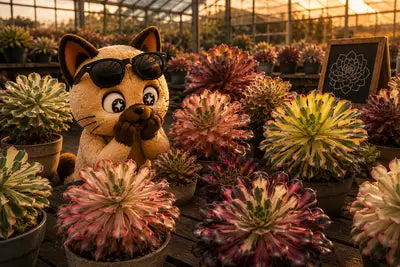
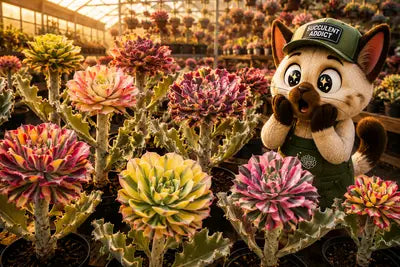
The rosettes were meant to look small, dense, symmetrical, and almost geometric. Often, plants that resembled artificial flowers, candies, or small sculptures were sought after.
California had already worked with interesting colors and very powerful ornamental shapes. But Korea took that aesthetic much further. Intense roses, lavender tones, extremely clean reds, and very marked contrasts began to appear.
Plants were no longer simply cultivated to survive. They were cultivated to look perfect in photographs. And that would become fundamental a few years later.
Social media completely changed the market
The true international explosion really came at the end of the 2010s. And the timing was practically perfect.
Instagram, Facebook, specialized forums, and international online sales made Korean Echeverias start circulating on the internet massively. And they looked completely different from anything that existed up to that moment.
Ultra compact rosettes, perfectly symmetrical, pink, lilac, or bluish colors, and almost artificial finishes. Many Western collectors literally thought they were fake plants.
That is when the term:
- Korean hybrids
- CH hybrids
- Korean Echeverias
begins to expand globally. And the market changes completely.
Changhee Succulents and the expansion of the Korean hybrid
One of the most important names of this entire stage is probably Changhee Succulents. Changhee greatly helped to popularize ultra-compact hybrids, pastel lines, and extremely symmetrical rosettes. But he also contributed to something even more important: the internationalization of the Korean hybrid.
From that moment on, countless plants began to circulate worldwide through Asian brokers, exporters, and international collector networks. And for the first time, Europe and America began to massively discover the so-called "Korean Echeverias."
During those years, hybrids and selections such as Amazing Grace, Pheromone, Meteor, or Red Velvet began to become especially popular, plants that perfectly represent the Korean obsession with extreme compactness, clean colors, and visual perfection.
Air Magic Nursery and the unreal plants
Another of the great historical names was Air Magic Nursery. And here, Korean aesthetics probably reaches one of its most extreme points.
Impossible hybrids begin to appear, brutal compactations, artificial colors, and extremely controlled shapes. Many plants seemed directly computer-generated.
And that was precisely part of their appeal.
During those years, hybrids and selections such as Fire Pillar, Laon (Raon), Omega Queen, Snow Angel, or Lavender Queen become especially popular, plants that perfectly represent the Korean obsession with ultra-compact rosettes, extreme symmetry, and almost unreal finishes.
The line between natural plant, decorative object, and ornamental design begins to become increasingly blurred.
Hwaga and the birth of the premium cultivar
As the market grew, some Korean nurseries began to operate almost like authentic luxury brands. One of the clearest examples was Hwaga.
Here, the concept of exclusive cultivar, limited lines, and premium collecting began to emerge strongly. The plants were no longer simply hybrids.
They began to become exclusive pieces and objects of desire for collectors around the world.
During those years, very recognizable selections associated with the Hwaga environment began to circulate, such as Ruby Crown, Pink Crystal, or Snow Queen, hybrids that perfectly represent the Korean obsession with extreme compactness, clean colors, and almost artificial visual perfection.
And probably here is where a large part of the modern mindset of the premium succulent market is born.
Korea completely changed the idea of "pretty plant"
And this is probably the most important aspect of this entire revolution.
Before Korea, many ornamental Echeverias still had a relatively natural appearance. Korea began to seek absolute perfection, extreme symmetry, unreal colors, and exaggerated compactness.
The plants stopped looking simply like succulents.
They began to look like perfect flowers, decorative figures, and small design pieces.
And honestly, a large part of the aesthetic that currently dominates Instagram, premium nurseries, and modern collections originates directly here.
But Korea had a huge problem
Although Korea completely dominated the premium market for many years, the model had significant limitations.
High costs, limited agricultural land, relatively small production, and a market that was still very artisanal. Many nurseries remained family-owned, small, and highly dependent on manual labor.
And while Korea revolutionized genetics and aesthetics… China was starting to prepare for something much bigger. Because if Korea had learned to design perfect plants… China was about to learn to produce them by the millions.
Continue exploring the history of modern succulents
The modern aesthetic of Echeverias did not arise from nothing. Behind the compact rosettes, extreme colors, and premium hybrids lies an international evolution where different countries completely transformed the collection of Crassulaceae.
In this series, we explore how California, Korea, Europe, and China redefined the modern market for variegated succulents.
Many of the data, stories, and connections we share here stem from our own experience within the industry, years of observing the evolution of the market, and conversations with collectors and international producers. Some parts of the modern history of succulents are not fully documented, and at times there are different versions regarding certain hybrids, dates, or origins.
If you detect any incorrect information or want to provide additional information about this market evolution, we would be happy to hear from you and continue expanding this series.
If you want to expand your collection, you can explore our variegated succulents, as well as variegated aeonium, rare succulents and classic variegated selected for collectors.
Follow us on Instagram to see new arrivals and restocks: