How to protect your variegated succulents during the summer
Share
Summer is one of the most delicate times for the cultivation of variegated succulents in Spain. With the arrival of the first significant temperature increases in the northern hemisphere, many plants enter thermal stress and drastically reduce their activity. At these moments, making incorrect decisions regarding watering or sun exposure can lead to burns, rot, and fungal attacks within days.
Unlike other ornamental plants, variegated succulents have less chlorophyll and tend to be more sensitive to extreme temperatures and excess moisture. Therefore, properly preparing the collection before summer is essential to reach the end of the season with healthy and compact plants.
In this guide, we will see how to adapt watering, sun exposure, and general care to protect your variegated succulents during the summer.
What NOT to do before a strong rise in temperatures
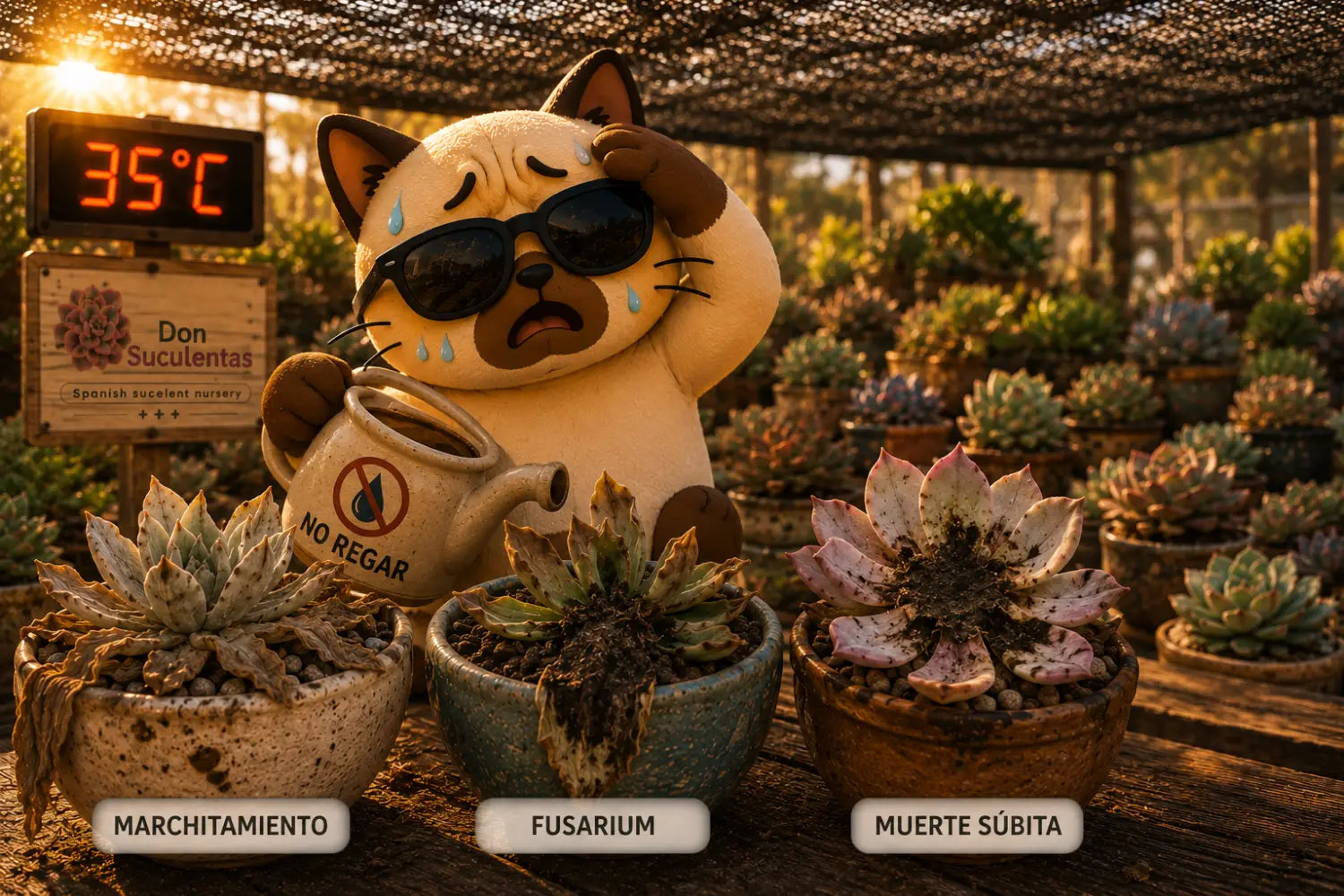
One of the most common mistakes is to water just before several days of intense heat. The combination of high humidity, warm substrate, and tropical nights creates the perfect environment for the proliferation of fungi and bacteria in the roots and neck of the plant.
When maximum temperatures exceed 30 °C and minimum nighttime temperatures remain above 20 °C, many succulents reduce their metabolism to a minimum. At that moment, the plant barely absorbs water, causing the substrate to remain moist for too long.
Under these conditions, excess water can end up causing root rot or fungal attacks within a matter of days.
Avoid direct exposure during critical hours
Another common mistake is leaving plants exposed to strong sunlight during the central hours of the day. In summer, especially in many areas of Spain, the sun between 12:00 and 18:00 can cause:
Leaf burns
Loss of powder
Extreme dehydration
Collapse of variegated tissues
Severe stress in albino plants or those with high variegation
Variegated succulents appreciate a lot of light, but that does not mean enduring extreme radiation during the most aggressive hours of summer.
The ideal is to use:
Shade mesh
Partial shade
Protected bright areas
East orientation
Ventilated patios with filtered light
A slightly dehydrated plant will always have a better chance of recovering than a plant that is rotten due to excess water, heat, or severe burns.
The best time to hydrate your succulents
When a temporary drop in temperatures or several milder days arrives, it is the ideal time to hydrate the collection before the harsher summer.
The goal is not to stimulate growth, but to help the plant accumulate water reserves and be better prepared for the weeks of thermal stress.
In this phase it is advisable:
Water in a controlled manner
Let the substrate dry completely afterwards
Avoid waterlogging
Prioritize active and healthy plants
Plants that are properly hydrated before major heat waves tend to withstand the summer much better.
How to water variegated succulents in summer
During the summer, less is often more.
Succulents are extremely resilient plants and can go weeks or even months without watering if the plant is healthy and properly cultivated.During that period, they can:
Slow down growth
Lose some hydration
Compact less
Enter partial dormancy
But this is usually much less dangerous than keeping a substrate moist under extreme temperatures.
When the nights remain very warm, excess moisture becomes the main enemy of the collection.
That’s why, during the summer:
It is better to space out watering
Use small amounts of water
Avoid unnecessary deep watering
Water only when temperatures give a slight break
When to water in summer
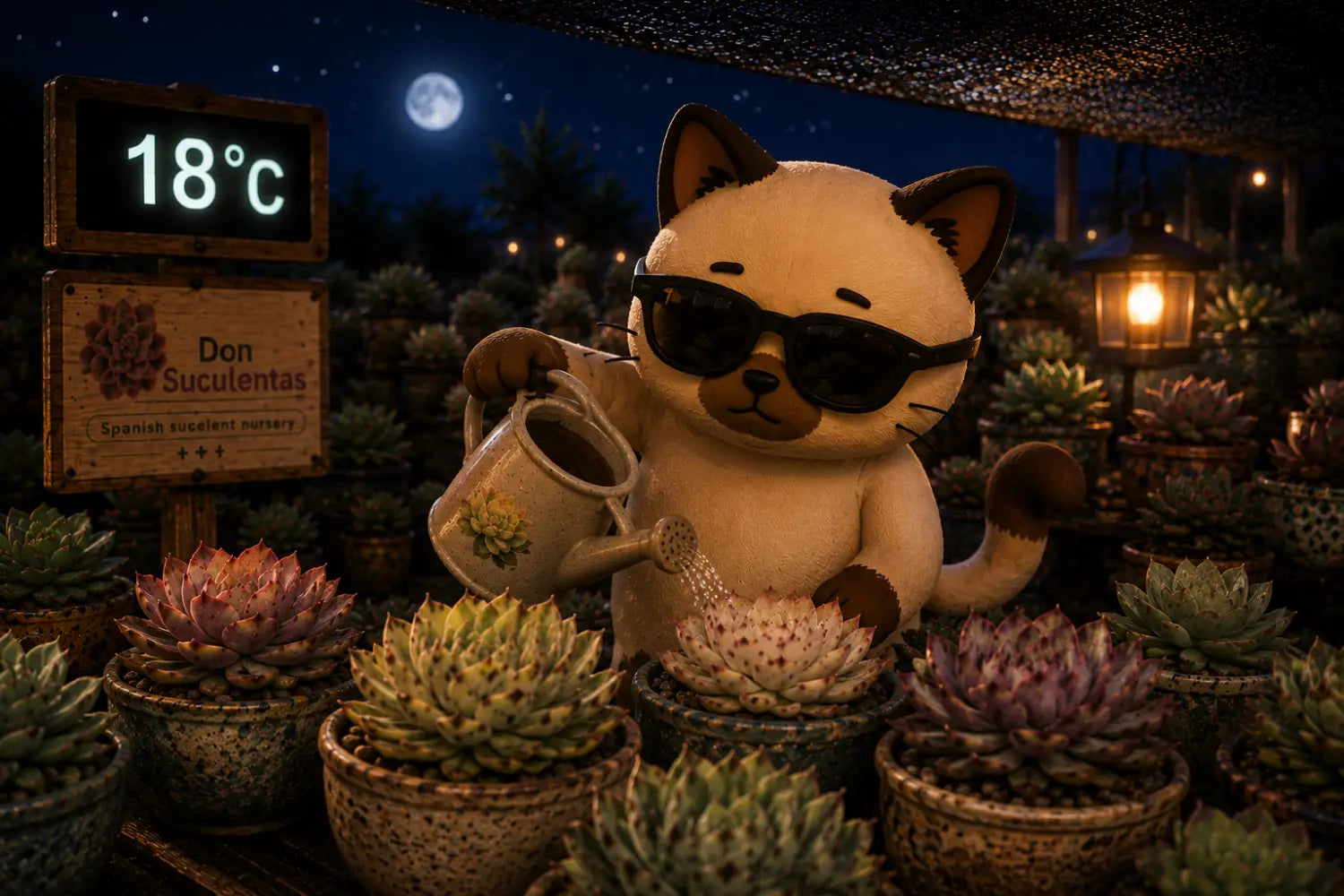
If there is a temporary drop in temperatures during the summer, you can take the opportunity to do a light watering.
The best option is usually:
Watering at night
Avoid wetting the center of the rosette
Allow good ventilation
Use very draining substrates
Watering at night helps the plant have several cooler hours to absorb some of the moisture before the heat rises again the next day.
Emergency measures during extreme heat waves
In extreme situations, some especially delicate plants may require more aggressive measures to survive the summer.
A technique used by many collectors is to temporarily keep some uprooted plants in areas of total shade and good ventilation.
If the plant is healthy and properly hydrated beforehand, it can withstand long periods outside the substrate, minimizing the risk of rot.
This is especially used for newly imported specimens, delicate plants, or varieties with a lot of variegation.
How to know if your succulent is suffering from heat
Some common signs of thermal stress are:
Soft leaves during peak temperature hours
Rapid color loss
Dry spots or burns
Closed and stagnant center
Wrinkled lower leaves
Completely stopped growth
In summer, this does not always mean that the plant needs water. Many times it is simply going into survival mode until cooler temperatures return.
Conclusion
Summer does not usually kill variegated succulents due to lack of water. What really destroys many collections is the combination of extreme heat, excessive humidity, and poor ventilation.
During the hottest weeks, plants slow down their activity and consume much less water. At these times, controlling irrigation and protecting the collection from the most aggressive sun is much more important than trying to keep the plants actively growing.
In the cultivation of variegated succulents, often the best decision during the summer is simply not to intervene too much and let the plants go dormant until milder temperatures return.
Learn how to cultivate variegated succulents step by step
If you want to delve into all the essential care —substrate, watering, light, pot, or stability of the variegation— we recommend our complete cultivation guide:
If you want to expand your collection and propagate variegated succulents, you can explore our variegated succulents, as well as variegated aeoniums, rare succulents, and classic variegated selections curated for collectors.
{"posts":[{"id":"gid://shopify/Article/612906664274","title":"Suculentas variegadas: guía de cultivo y cuidados esenciales","imageUrl":"https://cdn.shopify.com/s/files/1/0945/4288/9298/articles/guia-cultivo-echeverias-variegadas_159fe2a6-f769-4763-a5fc-258ee88e16a1.png?v=1771876017&width=400","imageAlt":"Conjunto de Echeverias variegadas con distintos patrones de variegación en cultivo","handle":"suculentas-variegadas-guia-cultivo","blogTitle":"Blog","blogHandle":"noticias","publishedAt":"2026-02-12T22:20:02Z","summary":"En esta guía completa sobre suculentas variegadas repasamos los cuidados esenciales para su correcto desarrollo: desde la aclimatación inicial hasta el riego por inmersión, el sustrato ideal, el tamaño de maceta o la estabilidad de la variegación. Un enfoque práctico orientado a cultivadores que buscan plantas sanas, compactas y con patrones de color estables a largo plazo.","postUrl":"https://www.donsuculentas.com/blogs/noticias/suculentas-variegadas-guia-cultivo"}, {"id":"gid://shopify/Article/610142912850","title":"Suculentas variegadas: cuidados y reproducción","imageUrl":"https://cdn.shopify.com/s/files/1/0945/4288/9298/articles/cuidados-basicos-suculentas-variegadas-reproduccion_f99ad440-07f9-4fbe-bbca-3f7771396290.png?v=1771878578&width=400","imageAlt":"Suculentas variegadas con múltiples rosetas tras reproducción por corte","handle":"suculentas-variegadas-cuidados","blogTitle":"Blog","blogHandle":"noticias","publishedAt":"2025-03-06T16:55:00Z","summary":"Las suculentas variegadas destacan por sus colores únicos y su rareza, convirtiéndolas en auténticas joyas para coleccionistas. Descubre qué es la variegación, sus tipos (natural e inducida), cómo cuidarlas correctamente y los mejores métodos de propagación para conservar su belleza. Aprende a mantener su coloración y evitar que reviertan a su forma original. ¡Conviértete en un experto en suculentas variegadas con Don Suculentas!","postUrl":"https://www.donsuculentas.com/blogs/noticias/suculentas-variegadas-cuidados"}, {"id":"gid://shopify/Article/613208686930","title":"Cómo identificar una suculenta variegada estable: tipos de variegación y estabilidad","imageUrl":"https://cdn.shopify.com/s/files/1/0945/4288/9298/articles/ChatGPT_Image_4_mar_2026_18_11_38_957ff582-230c-428a-a3ab-8548fb113a4e.png?v=1772644514&width=400","imageAlt":"suculenta variegada con patrón aurea perfecto ejemplo de variegación estable","handle":"identificar-suculenta-variegada-estable","blogTitle":"Blog","blogHandle":"noticias","publishedAt":"2026-03-24T09:00:00Z","summary":"Descubre los tipos de variegación en suculentas y aprende a identificar plantas con patrones estables.","postUrl":"https://www.donsuculentas.com/blogs/noticias/identificar-suculenta-variegada-estable"}, {"id":"gid://shopify/Article/612747772242","title":"Por qué las suculentas variegadas crecen más lento","imageUrl":"https://cdn.shopify.com/s/files/1/0945/4288/9298/articles/por-que-suculentas-variegadas-crecen-mas-lento_5e47ae41-c624-4356-8db7-1dca8d83f056.png?v=1771877025&width=400","imageAlt":"Comparativa de suculentas variegadas mostrando diferencia de tamaño y ritmo de crecimiento","handle":"crecimiento-suculentas-variegadas","blogTitle":"Blog","blogHandle":"noticias","publishedAt":"2026-02-23T00:48:02Z","summary":"Las suculentas variegadas crecen más lento por su propia naturaleza. En este post explicamos por qué ocurre, cómo funciona la variegación y por qué respetar su ritmo es clave para cuidarlas correctamente.","postUrl":"https://www.donsuculentas.com/blogs/noticias/crecimiento-suculentas-variegadas"}, {"id":"gid://shopify/Article/610209071442","title":"Cómo lograr suculentas más coloridas: técnicas y cuidados esenciales","imageUrl":"https://cdn.shopify.com/s/files/1/0945/4288/9298/articles/como-lograr-suculentas-mas-coloridas_eb525ca7-5552-40f2-8e07-6361b9ea933b.png?v=1771878134&width=400","imageAlt":"Suculentas variegadas con colores intensos tras exposición controlada al sol","handle":"suculentas-coloridas-tecnicas","blogTitle":"Blog","blogHandle":"noticias","publishedAt":"2025-03-16T16:54:36Z","summary":"Descubre cómo lograr suculentas vibrantes y coloridas mediante técnicas de estrés hídrico, solar y químico. Aprende a dominar estos métodos para realzar la belleza natural de tus plantas y obtener resultados sorprendentes. Conoce los factores esenciales que influyen en la intensidad de sus colores y cómo aplicarlos de manera efectiva.","postUrl":"https://www.donsuculentas.com/blogs/noticias/suculentas-coloridas-tecnicas"}, {"id":"gid://shopify/Article/612746035538","title":"Guía lunar para suculentas: cuándo regar, abonar, trasplantar y hacer esquejes","imageUrl":"https://cdn.shopify.com/s/files/1/0945/4288/9298/articles/guia-lunar-cultivo-suculentas-variegadas_9dcaaea3-7ebd-4865-9840-971732d7c355.png?v=1771874797&width=400","imageAlt":"Suculenta variegada en exterior nocturno representando el cultivo según ciclo lunar","handle":"guia-lunar-suculentas-variegadas","blogTitle":"Blog","blogHandle":"noticias","publishedAt":"2026-02-09T09:00:06Z","summary":"Las cuatro fases principales de la luna —luna nueva, cuarto creciente, luna llena y cuarto menguante— marcan distintos ritmos de actividad en las plantas. En el cultivo de suculentas, conocer estas fases nos permite elegir mejor cuándo regar, trasplantar, hacer esquejes o aplicar tratamientos, reduciendo riesgos y respetando el ciclo natural de la planta.","postUrl":"https://www.donsuculentas.com/blogs/noticias/guia-lunar-suculentas-variegadas"}],"isRemoveBranding":true,"heading":"Related posts","typeSearch":"post","device":"desktop","isShowExcerpt":true,"isShowPublishedDate":true,"hidden":false,"locked":false,"isBlankLink":false,"blockName":"Related posts","currentLocale":"en-US","cssContent":"","id":"Avada-Tool__RelatedBlogs-2"}
In this comprehensive guide on variegated succulents, we review the essential care for their proper development: from initial acclimatization to immersion watering, the ideal substrate, pot size, or the stability of variegation.A practical approach aimed at growers seeking healthy, compact plants with stable long-term color patterns.
Variegated succulents stand out for their unique colors and rarity, making them true gems for collectors. Discover what variegation is, its types (natural and induced), how to care for them properly, and the best propagation methods to preserve their beauty. Learn how to maintain their coloration and prevent them from reverting to their original form.Become an expert in variegated succulents with Don Suculentas!
Variegated succulents grow slower by their very nature. In this post, we explain why this happens, how variegation works, and why respecting their pace is key to caring for them properly.
Discover how to achieve vibrant and colorful succulents through techniques of water, solar, and chemical stress. Learn to master these methods to enhance the natural beauty of your plants and achieve stunning results. Understand the essential factors that influence the intensity of their colors and how to apply them effectively.
The four main phases of the moon —new moon, first quarter, full moon, and last quarter— mark different rhythms of activity in plants. In the cultivation of succulents, knowing these phases allows us to better choose when to water, transplant, take cuttings, or apply treatments, reducing risks and respecting the natural cycle of the plant.