Donsuculentas
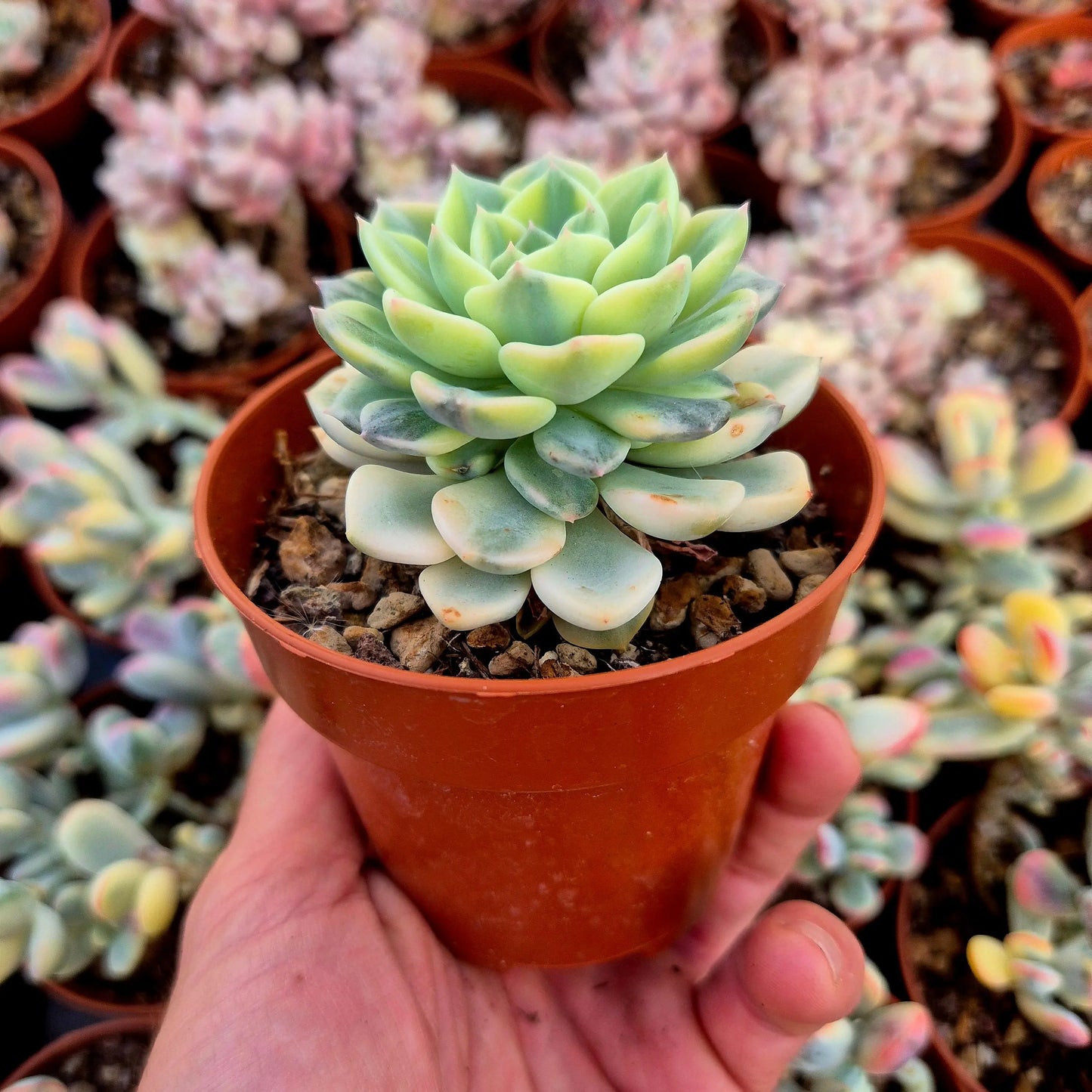
<tc>Graptoveria "Tinkerbell"</tc> variegated
<tc>Graptoveria "Tinkerbell"</tc> variegated
Could not load pickup availability
🗂️ Discontinued variety
This variety is no longer part of the active collection of Don Suculentas. Our catalog continuously evolves to maintain a high standard of quality, uniqueness, and cultivation behavior. Some plants, over time, no longer fit into this selection. Therefore, this specimen has been discontinued and will not be available again.
The
It has a slow but steady growth, and tends to remain low and tight, making it ideal for collections where space is limited.It reproduces mainly by offsets, although it can also be propagated by leaf with patience. Imported plant from Asia reproduced in our greenhouse.
| 🌞 Light | 💧 Watering | 🌱 Difficulty | 📈 Growth |
|---|---|---|---|

|
|
|
|
Graptoveria variegated: cultivation and care
The variegated Graptoveria combine characteristics of Echeveria and Graptopetalum, developing compact rosettes with a coloration heavily influenced by lighting, temperature, and environmental stability.
- 🌞 A lot of filtered light to maintain coloration and compactness
- 💧 Water only when the substrate is completely dry
- 🌡️ Avoid excess moisture and prolonged extreme heat
- 🌱 Moderate growth with greater activity in spring and autumn
The most variegated varieties may exhibit slower growth and greater sensitivity to excess intense sunlight, especially during summer. Good ventilation and a very draining substrate help maintain healthier and more compact rosettes.
With mild thermal differences between day and night, the characteristic pink, lilac, cream, and yellow tones of many ornamental Graptoveria hybrids tend to intensify better.
You can expand all technical information in our specialized guide: Complete guide to growing variegated succulents
Shipping
The plant is shipped bare root (without substrate or pot).
The image corresponds to the exact specimen or one of very similar size and coloration depending on availability.
More variegated succulents
View collection of variegated succulents
Related collections: