Donsuculentas
Echeveria "Cubic Frost" variegated
Echeveria "Cubic Frost" variegated
Could not load pickup availability
Echeveria "Cubic Frost" variegated – Origin: Asia
✨ Special selection
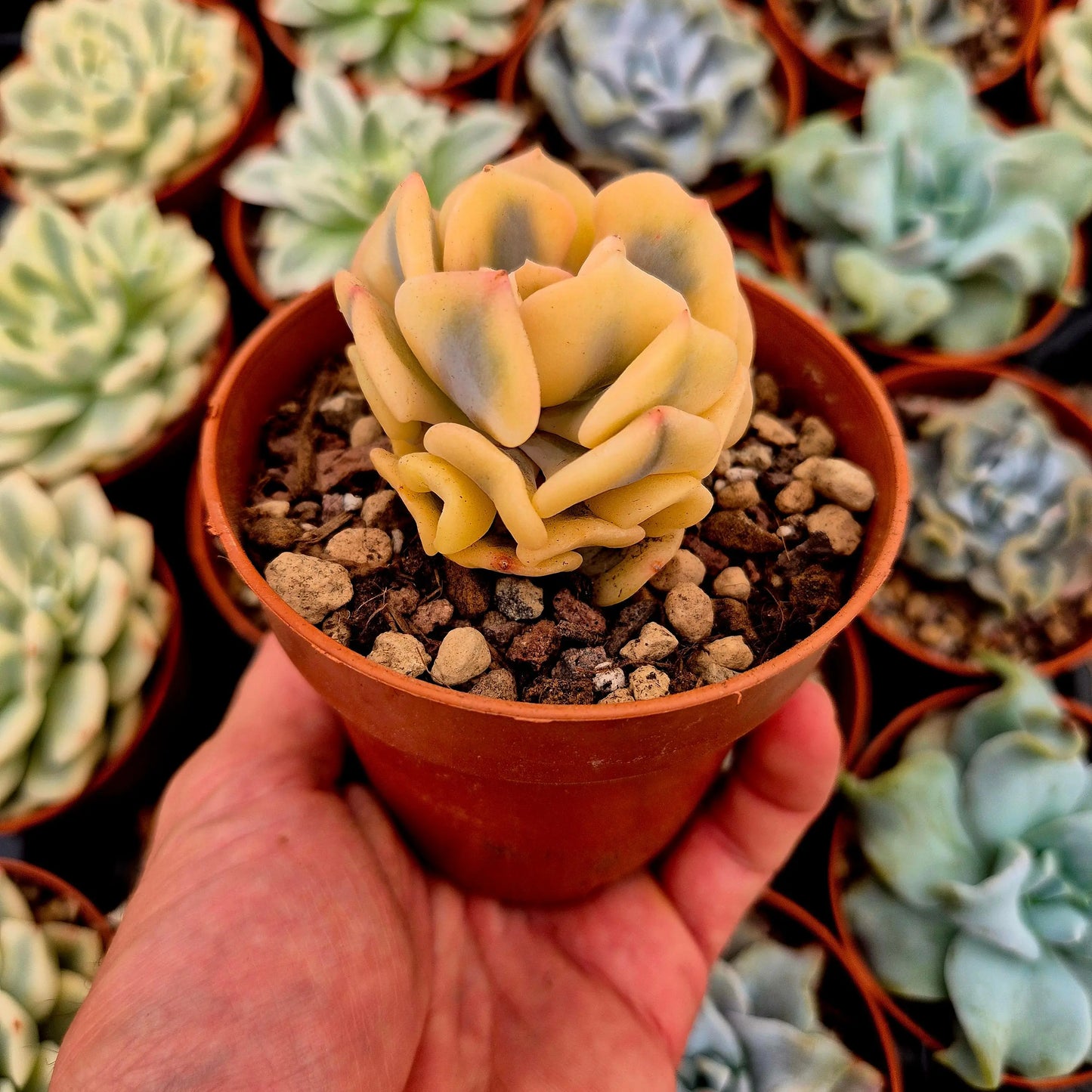
This specimen corresponds to a selection with an "aura" type variegation pattern, characterized by a particularly balanced distribution of cream areas and chlorophyll tissues, with smooth transitions and very subtle colors. It is a high-quality aesthetic expression within the same variety, appreciated for its visual harmony and the purity of its contrasts.
The Echeveria "Cubic Frost" variegated derives from the original hybrid developed by Renee O’Connell, maintaining its characteristic compact rosette of reduced size and its distinctive morphology. It features thick, fleshy leaves, with marked curvature and slight twisting, rounded apex, and gently undulating surfaces, generating an irregular yet balanced structure in the arrangement of the rosette.
The Echeveria "Cubic Frost" variegated combines a glaucous base in grayish and muted green tones with variegated areas in cream and pinkish hues. The pigmentation intensifies at the edges and exposed areas, where blurred mauve tones appear, while the variegation is distributed irregularly among the leaves, providing variability in the pattern of each specimen.
| 🌞 Light | 💧 Watering | 🌱 Difficulty | 📈 Growth |
|---|---|---|---|

|
|
|
|
Variegated Echeveria : cultivation and care
The variegated echeverias develop a lower photosynthetic capacity than their completely green counterparts, which directly affects their growth rate, sensitivity to excess sunlight, and tolerance to watering.
- 🌞 A lot of filtered light and soft exposure
- 💧 Water only with the substrate completely dry
- 🔥 Avoid extreme heat and prolonged humidity
- 🌱 Slower growth than non-variegated echeverias
Environmental stability, good ventilation, and avoiding sudden location changes help maintain more compact rosettes and a more stable variegation over time.
During intense summer, they may partially slow their growth, especially in warm climates. In these phases, controlling excess moisture is much more important than increasing watering frequency.
You can expand all the technical information in our specialized guide: Complete guide to growing variegated succulents
Shipping
The plant is shipped bare root (without substrate or pot).
The image corresponds to the exact specimen or one of very similar size and coloration depending on availability.
More variegated succulents
View collection of variegated succulents
Related collections: