Donsuculentas
<tc>Aeonium "Evening Glow"</tc> variegated
<tc>Aeonium "Evening Glow"</tc> variegated
Could not load pickup availability
Aeonium "Evening Glow" variegated - Origin: Don Suculentas
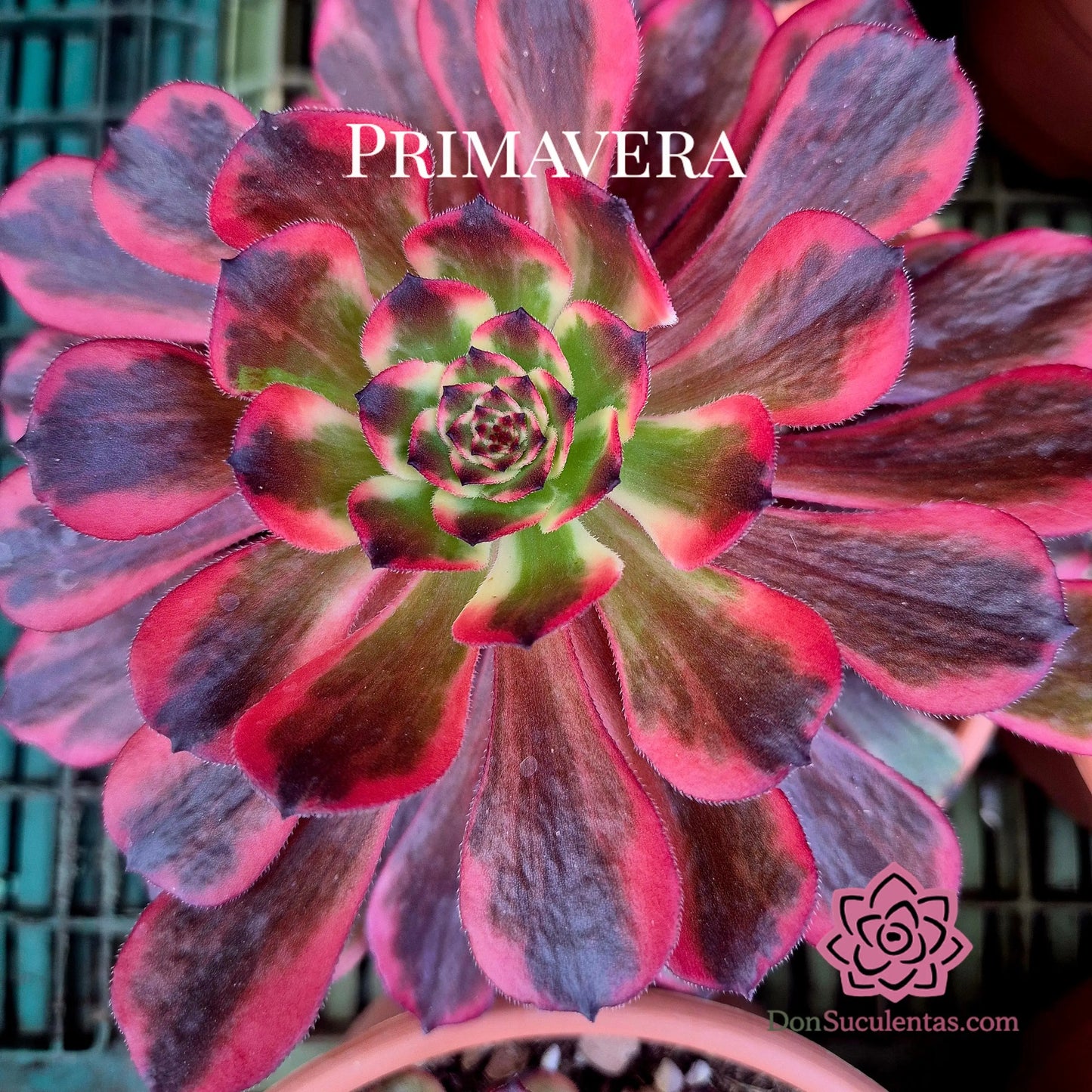
The Aeonium “Evening Glow” variegated is a mutation of A. “Mardi Grass”, belonging to the group of variegated aeonium collections most valued for the intensity of their color contrasts. During winter and in conditions of lower light, it develops leaves with a central green band accompanied by cream-yellow margins, maintaining the characteristic pattern of this genetic line. Its balanced structure and the clarity of the variegation ensure it retains a very ornamental appearance even in phases of softer coloration.
With increased light and temperature, the Aeonium “Evening Glow” variegated progressively intensifies its reddish tones at the edges while the center evolves into very dark shades, almost black during periods of maximum exposure.This strong contrast between intense reds and dark centers creates a very striking visual effect that gives meaning to its name. It exhibits balanced growth and, to date, has not shown any notable weaknesses in cultivation, particularly excelling in bright exposures. Plant imported from China and reproduced in our greenhouse.
Known names: ‘Burning Cloud’, ‘Huoshaoyun’, ‘Fire Cloud’
| 🌞 Light | 💧 Watering | 🌱 Difficulty | 📈 Growth |
|---|---|---|---|

|
|
|
|
Aeonium variegados : cultivation and care
Variegated aeoniums have a different growth cycle than many other succulents, developing mainly during autumn, winter, and spring, while in summer they significantly reduce their activity.
- 🌞 A lot of filtered light and good ventilation
- 💧 Moderate watering only with the substrate completely dry
- 🔥 Avoid intense sun and excess humidity during summer
- ❄️ Protect against prolonged frosts
During the summer dormancy, the rosettes tend to progressively close to protect the growth center from extreme heat. In this phase, excess moisture can easily cause root problems, especially with high temperatures and tropical nights.
Observing the plant and adapting to the actual growing climate is much more important than following strict watering schedules.
You can expand all the technical information in our specialized guide: Complete growing guide for
Shipping
The plant is shipped bare root (without substrate or pot).
The image corresponds to the exact specimen or one of very similar size and coloration depending on availability.
Explore more Aeonium variegados
View collection of
You can also discover other specialized categories: